

05 Jan 800G and 1.6T Data Centers: Why Single-Mode Fiber Is Overtaking Multimode
As data center link speeds advance to 800G and 1.6T, the historical cost and architectural advantages of multimode fiber (MMF) are being reexamined. At lower speeds, VCSEL-based SR optics offered a clear transceiver cost advantage over single-mode fiber (SMF) solutions. At 800 Gb/s, however, that gap has narrowed significantly.
Both 800G SR8 (multimode) and 800G DR8 (single mode) transceivers are implemented using eight parallel optical lanes, each delivering 100 Gb/s with PAM4 modulation at approximately 50 GBd per lane. Operating at these symbol rates requires advanced optical packaging, strict signal integrity control, and complex photonic design regardless of fiber type. As a result, the traditional price premium associated with single-mode optics has largely eroded, while the system-level benefits of single-mode fiber have become increasingly compelling.
Cabling Considerations at 800G and 1.6T
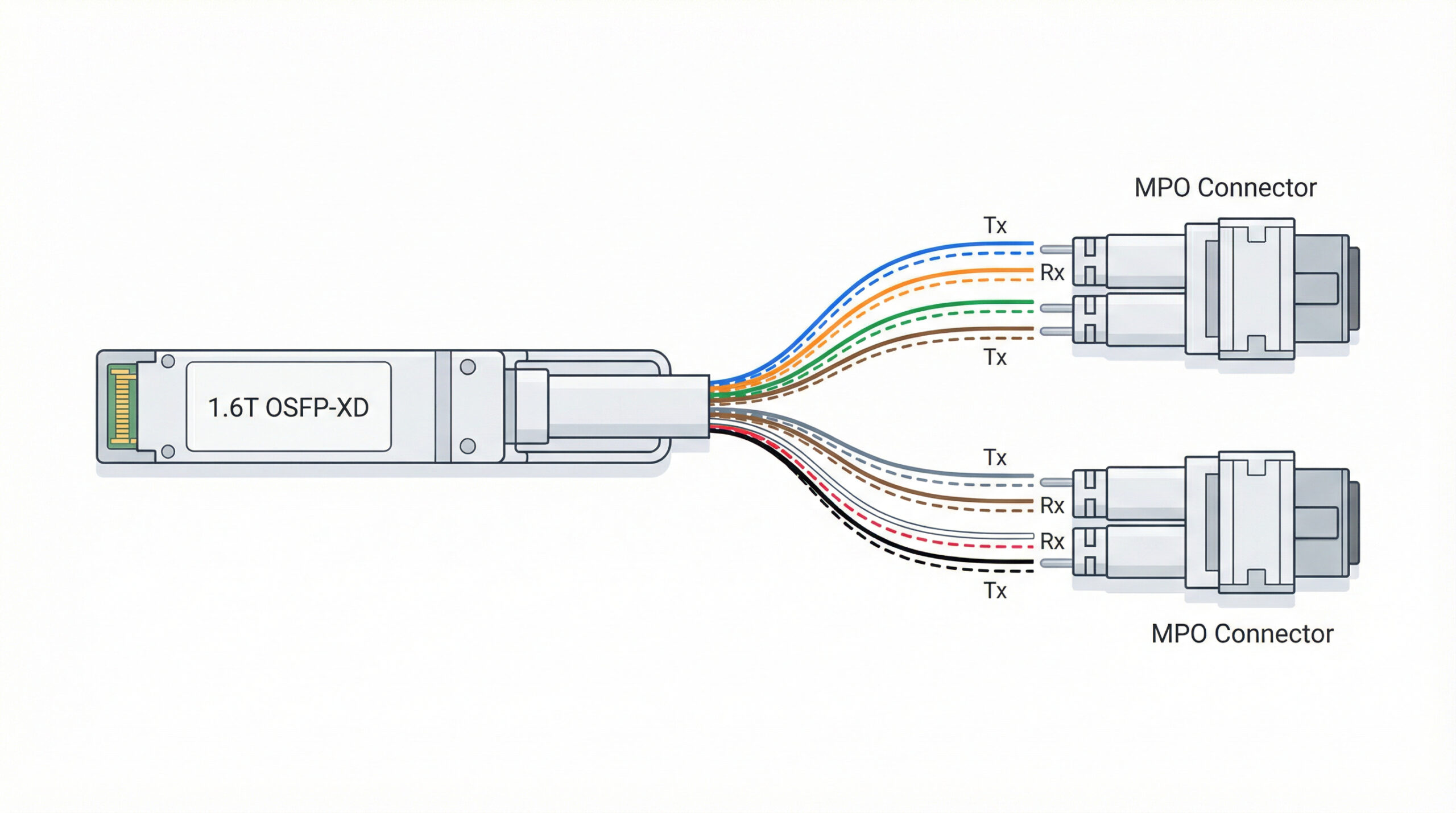
At 800G and 1.6T, both SR and DR solutions rely on parallel optics with similar fiber counts, commonly using MPO-12 or MPO-16 connectors. Although the physical cabling architectures appear similar, multimode and single-mode fibers exhibit very different performance characteristics at high baud rates.
Multimode fiber remains constrained by modal dispersion and bandwidth limitations, imposing strict reach limits and requiring careful management of fiber grades such as OM4 and OM5. These limitations become more pronounced as per-lane baud rates increase. In contrast, single-mode fiber provides predictable attenuation and chromatic dispersion, making link performance more robust and less sensitive to cabling variability at higher symbol rates.
Operational Simplicity Favors Single-Mode Fiber
Operational efficiency is a key priority for hyperscale data center operators. Multimode environments often introduce additional complexity through the coexistence of multiple fiber classes, tighter connector tolerances, and more extensive link characterization—challenges that scale with increasing baud rates.
Single-mode deployments standardize the physical layer around OS2 fiber, consistent test methodologies, and uniform performance expectations across short-reach, campus, and long-reach applications. This standardization reduces deployment risk, simplifies troubleshooting, and lowers long-term operational costs.
Scalability and Future-Proofing
As optical lane speeds continue to increase and modulation complexity moves beyond 100 GBd per lane, multimode fiber is approaching practical physical limits. Single-mode fiber, by comparison, supports a wide range of interfaces—including DR, FR, LR, and beyond—without requiring changes to the underlying cabling plant.
For hyperscalers designing data centers with lifecycles measured in decades, the ability to scale bandwidth without recabling provides a significant economic and operational advantage.
Total Cost of Ownership in the 800G Era
The industry shift toward predominantly single-mode data center architectures is not about eliminating multimode fiber entirely. Rather, it reflects a growing focus on total cost of ownership. At 800G and 1.6T, where high lane counts and elevated baud rates define transceiver design, the traditional cost benefits of multimode optics continue to diminish. Meanwhile, the operational simplicity, scalability, and future-readiness of single-mode fiber are becoming decisive factors.
For many hyperscale operators, single-mode fiber now represents the most straightforward and sustainable long-term choice.
To build deeper expertise in fiber types, baud-rate scaling, high-speed pluggable optics, and modern optical network design, consider participating in an OTT optical networking training programs, Certified Optical Network Associate (CONA) and Certified Optical Network Engineer (CONE).
Sorry, the comment form is closed at this time.