The rapid evolution of hyperscale infrastructure, high-density artificial intelligence (AI) workloads, and ultra-low-latency financial services has transformed Charlotte, North Carolina, into one of the most critical optical transport nodes in the Southeastern United States. As metro networks migrate from legacy interfaces to disaggregated multi-terabit architectures, the demand for certified, expert-level infrastructure professionals has peaked.
FiberGuide addresses this critical skill requirement by delivering advanced, vendor-neutral Fiber Optic Training in Charlotte. Developed by Optical Technology Training (OTT) and delivered by veteran systems engineers, our CONA (Certified Optical Network Associate) and CONE (Certified Optical Network Engineer) programs provide foundational physics, link-engineering formulas, and structural design disciplines needed to architect resilient, future-ready optical networks.
Charlotte’s Role as a High-Capacity Telecom & Data Infrastructure Nexus
Strategically positioned midway between the primary internet exchange points of Ashburn, Virginia, and Atlanta, Georgia, Charlotte operates as a vital aggregation point for long-haul terrestrial optical paths and regional distribution rings.
The city’s infrastructure is anchored by deep high-capacity enterprise networks, dense dark-fiber availability, and multi-gigabit deployments from access providers like AT&T, Google Fiber, Spectrum, and Lumos. This foundational footprint supports a massive enterprise data ecosystem across diverse vertical sectors:
- Global Financial Services & Fintech: As a premier U.S. financial center, institutions operating in Uptown Charlotte rely on deterministic, ultra-low-latency optical links to execute high-frequency transactions and maintain synchronous data replication between geographically diverse active-active business continuity facilities.
- Hyperscale & Multi-Tenant Data Centers: The metropolitan footprint hosts more than a dozen carrier-neutral data centers and high-density colocation facilities operated by market leaders including Flexential (North & South campuses), TierPoint (Center Park & North Myers facilities), H5 Data Centers, Cogent, and Lumen Technologies.
- Strategic Fiber Manufacturing Proximity: Charlotte’s optical strategy is directly integrated with global production infrastructure. Nearby Hickory, NC, serves as the global headquarters for Corning Optical Communications. Massive AI-driven supply agreements—such as Corning’s large-scale manufacturing partnerships with Meta Platforms—underscore the region’s central role in pioneering the physical media supporting next-generation transport architectures.
With the Charlotte City Council’s implementation of structural code reviews and infrastructure optimization frameworks for mission-critical facilities, maximizing existing fiber plant efficiency is paramount. To prevent terabit bottlenecks, network operators, utilities, and hyperscale enterprises must look beyond basic physical deployment and invest in rigorous optical networking training Charlotte programs to master the complexities of spectral efficiency and link engineering.
Who Benefits from Vendor-Neutral Technical Certification?
Many industry courses focus narrowly on a single manufacturer’s command-line interface (CLI) or proprietary hardware chassis. FiberGuide’s optical networking certification paths are completely vendor-neutral, diving deep into the fundamental physics, international ITU standards, and engineering trade-offs that govern all optical transport systems.
This comprehensive technology-focused approach guarantees that the design models, optical power budgets, and impairment-mitigation techniques learned are universally applicable across all major equipment ecosystems, including Ciena, Infinera, Cisco, Lumentum, and Nokia.
|
Professional Role
|
Practical Application of CONA & CONE Knowledge
|
|
Network Architects & Planners
|
Model advanced metro DWDM architectures, forecast capacity requirements, and validate transponder/muxponder selection for multi-terabit DCI links.
|
|
Outside Plant (OSP) Engineers
|
Analyze single-mode fiber variants, optimize link budgets, and interpret complete fiber characterization data profiles.
|
|
Data Center Operations Personnel
|
Manage high-density structural fiber patching, diagnose optical return loss (ORL), and transition networks to 400G/800G optical interfaces.
|
|
Telecom Carrier Specialists
|
Deploy disaggregated line systems, manage reconfigurable optical add-drop multiplexers (ROADMs), and scale regional transport footprints.
|
|
Utility & Smart Grid Engineers
|
Leverage Optical Ground Wire (OPGW) footprints for ultra-reliable long-haul utility backhaul, SCADA telemetry, and dark fiber leasing.
|
CONA Certification: Optical Network Associate Curriculum
The Certified Optical Network Associate (CONA) program is a rigorous, 5-day technical course designed to build an authoritative foundation in single-channel and multi-channel optical communication platforms. This course is ideal for professionals seeking formal fiber optic certification Charlotte to confidently design, specify, and test high-speed transport links.
Core Focus Areas & Technical Competencies:
- Fiber Optic Fundamentals & Materials: Understanding geometric optics, total internal reflection, core/cladding material variations, and the physical performance profiles of ITU-T G.652 (standard single-mode), G.655 (NZDSF), and G.657 (bend-insensitive) fiber assets.
- Optical Communications Basics: Mastering direct-detection transmission systems, transponder functions, optical-to-electrical-to-optical (OEO) regeneration points, and signal-to-noise optimization.
- Wavelength Division Multiplexing (Wavelength Management): Comprehensive analysis of CWDM and DWDM fundamentals. Designing within the ITU grids, spacing channels accurately, and leveraging EDFA (Erbium-Doped Fiber Amplifier) capabilities across the C and L bands.
- Optical Transport Technologies & Metrics: Engineering optical power budgets and calculating total permissible insertion loss, connector tolerances, and splice degradation parameters.
- Introduction to Optical Network Design: Synthesizing components into operational point-to-point, protected ring, and metro mesh topologies. Participants learn to specify active and passive components to build cost-effective, high-availability routes tailored for corporate backhaul or ISP transport.
CONE Certification: Optical Network Engineer Curriculum
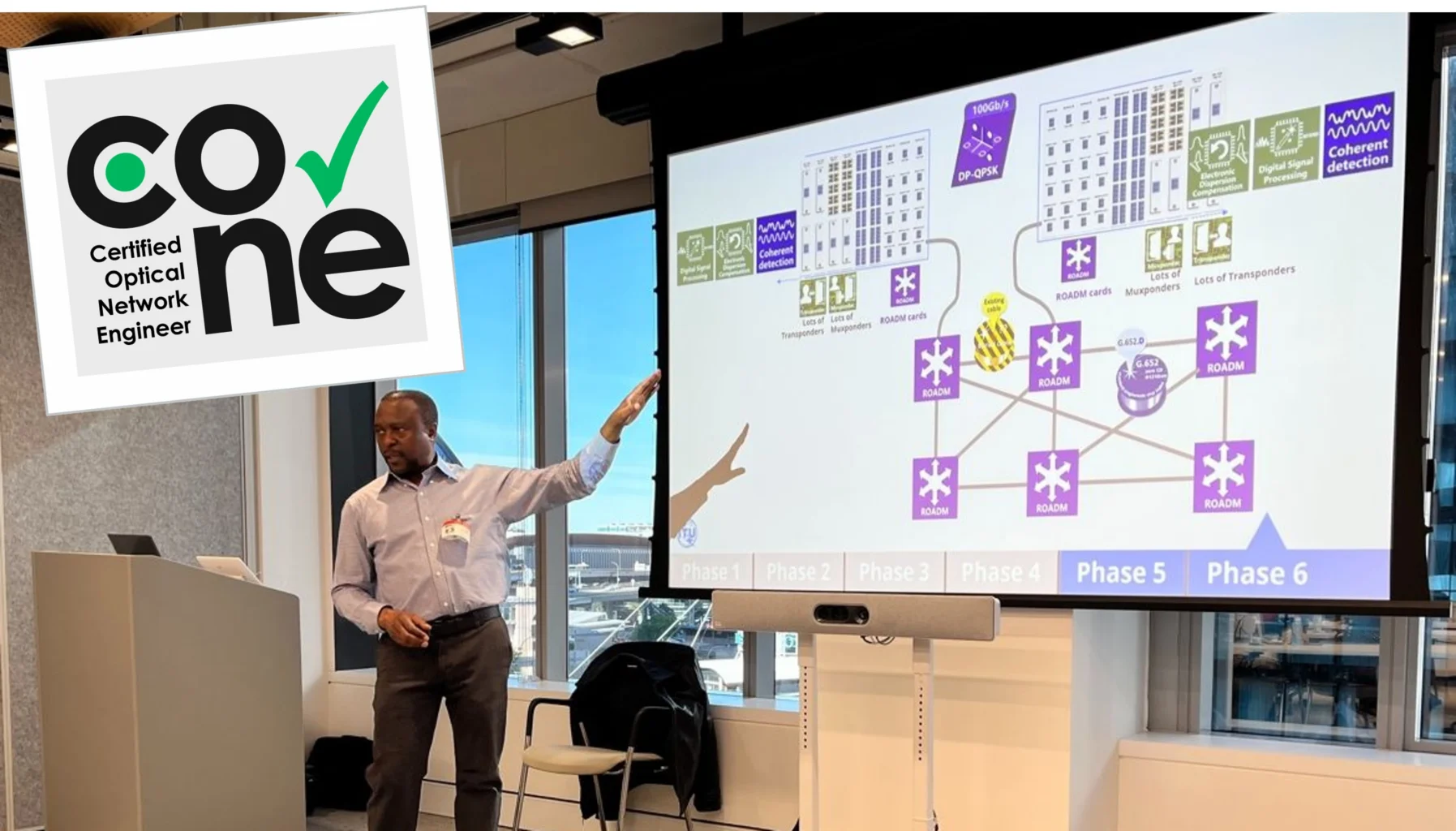
For senior infrastructure specialists, system architects, and senior transport planners, the Certified Optical Network Engineer (CONE) masterclass represents the pinnacle of advanced optical network engineer training. This 5-day technical track focuses on high-capacity transport design, moving past direct detection into the complex multi-terabit domain of subcarrier aggregation and phase-modulated coherent systems.
Advanced Engineering Competencies Covered:
- Advanced DWDM & Flex-Grid Systems: Transitioning from rigid 50GHz/100GHz fixed channels to software-defined, flexible-grid channels (ITU-T G.694.1) to optimize spectral density for mixed-rate payloads.
- Coherent Optics & Advanced Modulation: In-depth breakdown of digital signal processing (DSP) combined with coherent detection. Engineering links utilizing Quadrature Phase Shift Keying (QPSK) and Quadrature Amplitude Modulation 16-QAM}, 64-QAM, alongside dual-polarization multiplexing DP-QAM.
- High-Capacity Data Center Interconnects (DCI): Architecting low-latency, high-density point-to-point interconnects using modern pluggable form factors (QSFP-DD, OSFP) running 400ZR, 400ZR+, and 800G coherent optics across local multi-tenant nodes.
- Long-Haul Transport Network Design: Calculating optical signal-to-noise ratios OSNR across cascaded amplification stages to ensure unregenerated data delivery across multi-state routes.
- Managing Physical Optical Impairments: Modeling and mitigating performance constraints, including Chromatic Dispersion CD, Polarization Mode Dispersion PMD, Self-Phase Modulation (SPM), and Four-Wave Mixing (FWM).
- Comprehensive Fiber Characterization: Analyzing bi-directional Optical Time-Domain Reflectometer (OTDR) traces, end-to-end spectral attenuation profiles, and high-order dispersion datasets to validate if dark fiber assets can support coherent high-speed upgrades.
- Capacity Planning & Spectral Efficiency: Balancing symbol rates, Forward Error Correction (FEC) overhead, and Shannon capacity limits to extract the maximum bit-rate per hertz out of dark fiber routes.
Public Masterclasses vs. Private Custom Corporate On-Site Training
To satisfy diverse organizational needs, FiberGuide delivers its telecom training Charlotte NC curriculum through a highly flexible delivery matrix:
- Prescheduled Public Open-Enrollment Classes
Perfect for individual engineers, local technical consultants, or companies looking to upscale smaller numbers of staff. Hosted at clean, modern corporate training locations in the Charlotte metropolitan area, these sessions foster excellent peer-to-peer technical networking across different technology ecosystems.
- Private Custom Corporate Training
If you are managing a larger deployment team, network operations center (NOC) shift, or corporate architecture department, FiberGuide can deliver the entire CONA or CONE program as a private engagement. These sessions can be conducted directly at your enterprise facility or inside your data center headquarters in the Charlotte region. Private courses allow for tailored deep-dives into your organization’s specific fiber topologies, single-mode fiber types, and planned equipment roadmaps.
Accelerate Your Network Engineering Career in the Southeast
Enrolling in specialized telecom training Charlotte or advanced optical communications training provides a clear competitive advantage in a highly demanding field. As regional telecom infrastructure scales up to handle specialized AI environments, holding an OTT certification proves to major employers that you possess a deep, physics-based understanding of fiber transmission engineering.
Whether you are looking to advance your skillset inside a global bank’s infrastructure team, optimize multi-site cloud fabrics, or oversee large-scale dark fiber operations across North Carolina, our structured engineering paths will equip you with the tools needed to design scalable, secure, and resilient optical networks.
Frequently Asked Questions
What is the primary difference between CONA and CONE certifications?
The CONA (Associate) certification concentrates on single-channel and multi-channel system design utilizing direct-detection methodologies, making it ideal for foundational enterprise, metro, and middle-mile transport infrastructure. The CONE (Engineer) certification transitions into advanced high-speed coherent networking (100G, 40G, 800G, and beyond), focusing on phase modulation, complex digital signal processing (DSP), flex-grid layouts, and advanced impairment management over long-haul or high-density DCI paths.
Are these fiber optics courses in Charlotte focused on hands-on cable splicing?
No. FiberGuide’s CONA and CONE certifications are focused on optical system design, engineering, and network architecture. Unlike foundational vocational courses that focus on mechanical fiber striping, mechanical splicing, or basic patch terminal installation, our curriculum focuses on link-budget calculation, dispersion management, optical component specification, and network topology planning.
Why is vendor-neutral optical network engineer training preferable to hardware-specific classes?
Hardware-specific training teaches you how to configure a particular manufacturer’s proprietary chassis via their specific software interface. FiberGuide’s vendor-neutral engineering approach teaches you the underlying physics, optical principles, and international criteria that govern all hardware platforms. This baseline understanding allows engineers to easily adapt to any manufacturer equipment ecosystem (such as Cisco, Ciena, or Infinera) and make objective architectural choices.
Can FiberGuide customize in-house training for our specific corporate network deployment?
Yes. Wherever possible our training programs can be customized to match your organization’s real-world footprint. We work closely with your engineering managers beforehand to align our technical modules with your current optical architecture, planned 400G/800G upgrades, preferred single-mode fiber types, and specific operational requirements.
Optimize Your Core Infrastructure
Equip your design and operations teams with the advanced link engineering principles needed to prevent multi-terabit bottlenecks. Get in touch with our optical transport specialists today to reserve your seat in our next open enrollment session or to scope a custom, private in-house certification program.