

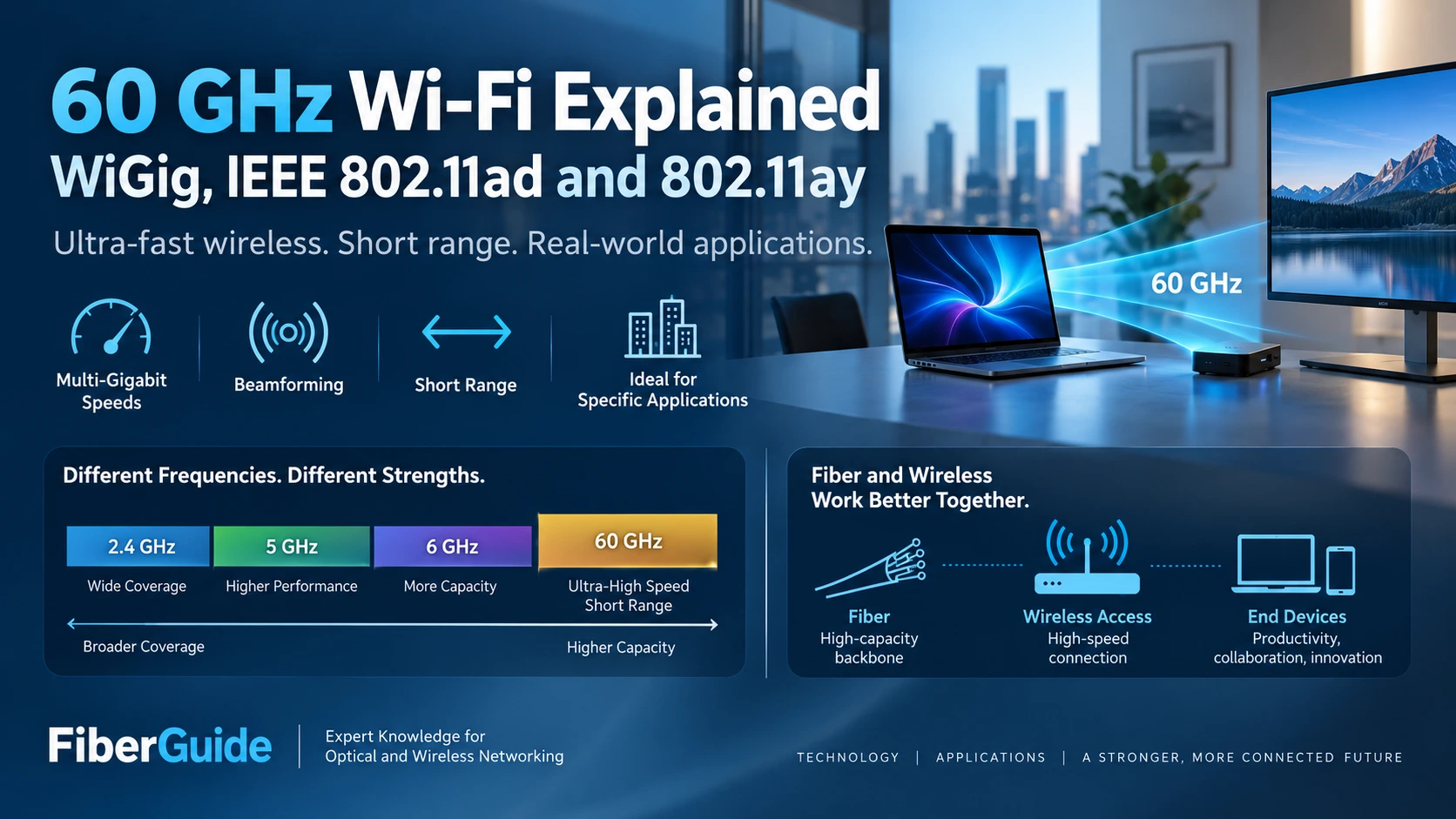
30 Jan 60 GHz Wi-Fi Explained: WiGig, IEEE 802.11ad and 802.11ay
60 GHz Wi-Fi and WiGig: High-Speed Wireless Over Short Distances
Wireless networking has traditionally relied on the 2.4 GHz and 5 GHz bands, with 6 GHz becoming increasingly important with Wi-Fi 6E and Wi-Fi 7. But there is another part of the spectrum that offers something very different: 60 GHz wireless networking.
Often referred to as WiGig, 60 GHz Wi-Fi uses millimeter-wave frequencies to deliver extremely high data rates over relatively short distances. The technology is particularly interesting for applications where high bandwidth and low latency are more important than long range.
- What Is 60 GHz Wi-Fi?
- WiGig: Very High Speed Over Short Distances
- Why Does 60 GHz Have Such Limited Range?
- Beamforming Is Essential
- IEEE 802.11ad vs. 802.11ay
- How Does 60 GHz Compare With Wi-Fi 7?
- Is 60 GHz Wi-Fi Still Relevant?
- 60 GHz and the Future of Wireless Networking
- Fiber and 60 GHz Wireless
- Optical Networking Training
- Conclusion
What Is 60 GHz Wi-Fi?
60 GHz Wi-Fi operates in the millimeter-wave portion of the radio spectrum. The term “60 GHz” is commonly used to describe a range of unlicensed spectrum around this frequency, rather than a single frequency.
The technology was standardized initially through IEEE 802.11ad, which introduced very-high-throughput WLAN operation around 60 GHz. IEEE 802.11ad was published in 2012 and became the foundation for what is commonly called WiGig.
A later standard, IEEE 802.11ay, significantly enhanced the technology. Published in 2021, 802.11ay was designed for operation in license-exempt bands above 45 GHz and specifies a mode capable of at least 20 Gb/s maximum MAC-layer throughput.
WiGig: Very High Speed Over Short Distances
The biggest attraction of 60 GHz Wi-Fi is bandwidth.
At these frequencies, very wide channels can be used to support multi-gigabit wireless connections. This makes 60 GHz attractive for applications such as:
- Wireless docking
- High-speed device-to-device connections
- Virtual and augmented reality
- High-resolution multimedia
- Short-range wireless backhaul
- Fixed wireless links
- Enterprise and specialized networking applications
The tradeoff is range. 60 GHz is not intended to replace conventional Wi-Fi across an entire home, office, or campus. Instead, it can complement lower-frequency wireless technologies where a short-range, very-high-capacity connection is required.
Why Does 60 GHz Have Such Limited Range?
The short range of 60 GHz is one of its defining characteristics.
Radio signals experience increasing free-space path loss as frequency increases. In addition, atmospheric absorption becomes more significant at millimeter-wave frequencies. Oxygen absorption around 60 GHz can contribute additional attenuation.
Perhaps more importantly for indoor applications, 60 GHz signals do not penetrate walls and other obstructions as effectively as lower-frequency Wi-Fi signals.
This can be a disadvantage for general-purpose wireless networking, but it can also be an advantage.
Because signals are more easily confined to a room or line-of-sight area, 60 GHz can potentially support high-capacity connections with less interference between physically separated areas.
Beamforming Is Essential
60 GHz systems make extensive use of directional antennas and beamforming.
Instead of transmitting energy equally in every direction, the system can electronically steer and concentrate the radio signal toward the receiving device. This helps compensate for the higher propagation loss at millimeter-wave frequencies.
Beamforming is therefore an important part of making practical high-speed 60 GHz communications possible.
IEEE 802.11ad vs. 802.11ay
The easiest way to understand the evolution of WiGig is to compare the two standards.
| Technology | Description |
|---|---|
| IEEE 802.11ad | Original 60 GHz Wi-Fi/WiGig standard, providing very-high-throughput operation around 60 GHz |
| IEEE 802.11ay | Enhanced 60 GHz technology designed to provide substantially higher throughput and improved capabilities |
| Wi-Fi 6/6E | High-efficiency Wi-Fi operating primarily below 7.125 GHz |
| Wi-Fi 7 (802.11be) | Extremely High Throughput Wi-Fi operating across 2.4, 5 and 6 GHz |
IEEE 802.11ay should not be confused with an upcoming technology. It was published in 2021. IEEE specifies at least one 802.11ay mode capable of 20 Gb/s maximum MAC throughput.
How Does 60 GHz Compare With Wi-Fi 7?
This is an important distinction when discussing 60 GHz in 2026.
Wi-Fi 7 (IEEE 802.11be) operates in the 2.4, 5 and 6 GHz bands and was designed for extremely high throughput, improved latency and backward compatibility with existing Wi-Fi devices. IEEE specifies a mode capable of at least 30 Gb/s maximum MAC throughput.
Wi-Fi 7 is therefore much better suited to mainstream wireless LAN applications.
60 GHz, by comparison, occupies a more specialized position:
Wi-Fi 7:
High performance + broader coverage + compatibility with existing Wi-Fi infrastructure
60 GHz / WiGig:
Very high bandwidth + highly directional transmission + short range
They are therefore better viewed as complementary technologies rather than direct competitors.
Is 60 GHz Wi-Fi Still Relevant?
Absolutely—but its role is more specialized than many early predictions suggested.
The original vision of 60 GHz Wi-Fi included replacing conventional wired connections and providing extremely high-speed wireless networking throughout homes and offices. In practice, the propagation characteristics of millimeter-wave frequencies make that difficult.
Instead, 60 GHz is particularly interesting where its characteristics are advantageous.
Potential applications include:
Wireless Backhaul
A 60 GHz link can provide high-capacity wireless connectivity between network devices over relatively short distances, potentially reducing the need for physical cabling in some installations.
Wireless Docking
A computer or workstation could establish a very high-speed wireless connection to nearby displays, storage, peripherals or network equipment.
Immersive Applications
Applications involving virtual reality, augmented reality and high-resolution video can benefit from high bandwidth and low latency.
Enterprise and Specialized Networks
Directional, short-range links can be useful in environments where high capacity is required and the network topology is relatively controlled.
60 GHz and the Future of Wireless Networking
The evolution of Wi-Fi has not stopped with Wi-Fi 7. IEEE's 802.11 working group is already working on future generations of WLAN technology, including projects aimed at further improving throughput, latency, efficiency and network intelligence.
There is also ongoing work examining the integration of millimeter-wave frequencies into future WLAN architectures. IEEE documentation identifies work on Integrated Millimeter Wave (IMMW) WLAN technology covering frequencies between approximately 42 and 71 GHz.
This points toward an increasingly diverse wireless environment in which different frequency bands are used according to their strengths.
Fiber and 60 GHz Wireless
For network engineers, perhaps the most important point is that high-speed wireless does not eliminate the need for fiber.
In many modern networks, fiber provides the high-capacity backbone while wireless provides connectivity at the network edge.
This creates a complementary architecture:
Fiber → high-capacity transport → wireless access → end device
As wireless speeds continue to increase, the optical network supporting the wireless infrastructure must also provide sufficient bandwidth, low latency and scalability.
For professionals working in optical networking, understanding both sides of this architecture is increasingly valuable.
Build Your Optical Networking Skills
High-speed wireless technologies such as 60 GHz Wi-Fi and WiGig depend on high-capacity network infrastructure behind the wireless edge. Understanding fiber optics, optical transport, DWDM, amplifiers and modern high-capacity optical systems can help network professionals understand the complete communications architecture.
Conclusion
60 GHz Wi-Fi and WiGig represent an interesting approach to high-speed wireless networking. IEEE 802.11ad established the foundation for 60 GHz WLANs, while IEEE 802.11ay extended the technology with substantially higher throughput and enhanced capabilities.
The technology's greatest limitation—short range and poor penetration through obstacles—is also part of what makes it useful for certain applications. Rather than replacing conventional Wi-Fi, 60 GHz is better viewed as a specialized high-capacity wireless technology that can complement Wi-Fi 6E, Wi-Fi 7 and future wireless technologies.
And behind many of these wireless connections, there is still an essential piece of infrastructure: fiber optics.
Advance Your Optical Networking Career
Whether you are building a foundation in optical communications or developing advanced skills in coherent optical networking, FiberGuide offers professional training designed for today's high-capacity networks.
View FiberGuide Optical Network Training
Sorry, the comment form is closed at this time.