

19 May Why AI Needs 800G and 1.6T Optical Networks: The Hidden Infrastructure Behind Large AI Models
Artificial intelligence may look like software on the surface, but underneath every chatbot, image generator, and large language model is an enormous physical infrastructure problem.
The AI revolution is not powered by prompts alone.
Behind every generative AI model are thousands of GPUs exchanging massive amounts of data across ultra-high-speed optical networks. As AI systems become larger and more sophisticated, networking has become one of the most critical bottlenecks in AI infrastructure.
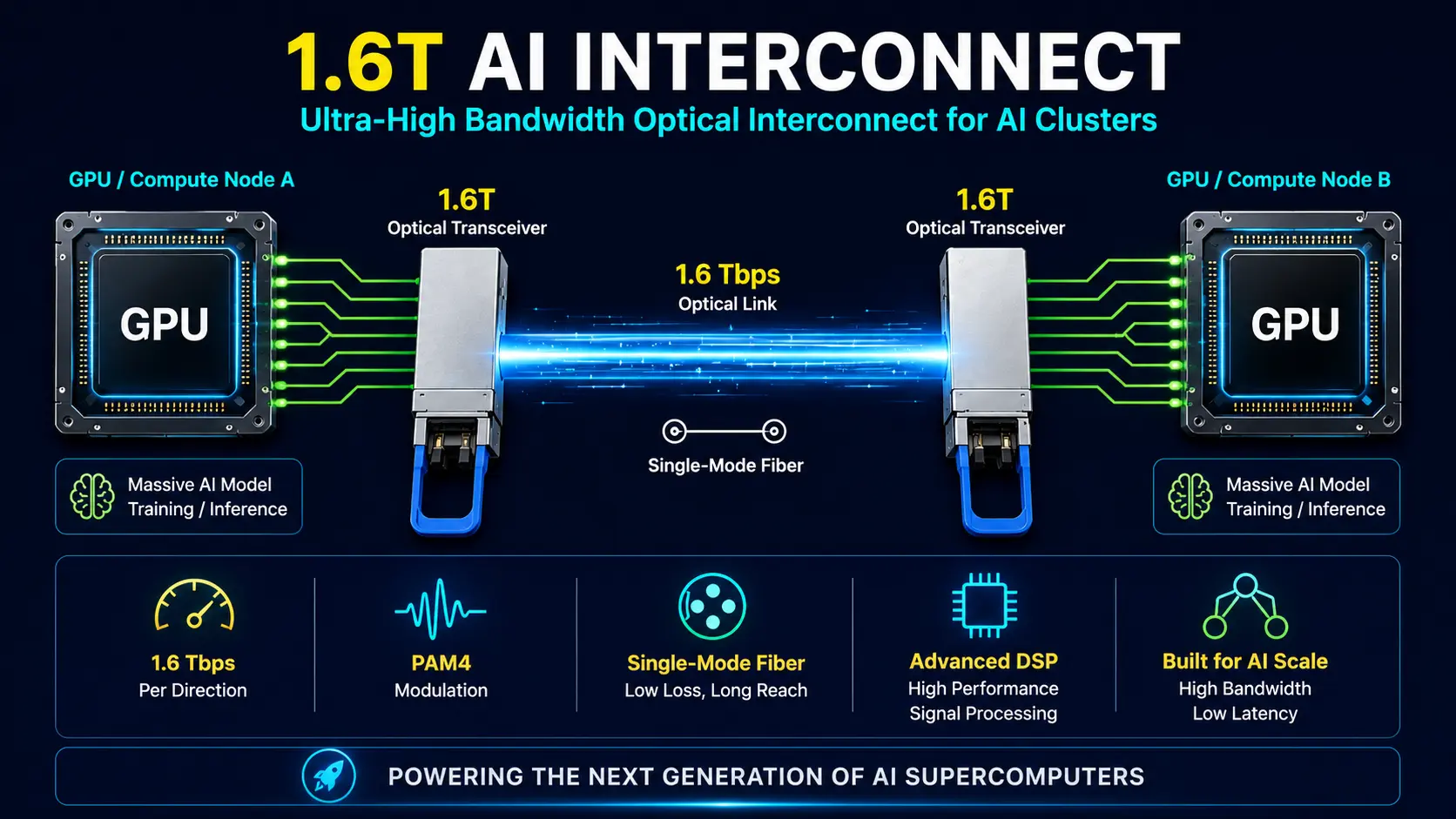
This is why technologies such as 400G, 800G, and 1.6T optical interconnects are rapidly becoming essential to modern AI data centers.
The Massive Computing Demands of Large AI Models
Modern AI models such as large language models (LLMs), generative AI systems, and multimodal models require staggering amounts of computation.
Training a frontier AI model can involve anywhere from 10^24 to 10^26 floating-point operations (FLOPs). That translates to millions of billions of billions of mathematical calculations. Even the most powerful laptop processors would take hundreds of millions of years to complete workloads of this scale. To solve this challenge, the AI industry relies on GPUs.
Why GPUs Are Critical for AI Training
Graphics Processing Units (GPUs) are specialized processors designed to perform massive numbers of calculations simultaneously.
Unlike traditional CPUs, which are optimized for sequential tasks, GPUs excel at parallel processing. This makes them ideal for AI workloads where huge volumes of tensor calculations happen at the same time.
For example, the NVIDIA H100 GPU can deliver approximately:
- ~4 petaFLOPS of AI performance
- 80 GB of HBM3 high-bandwidth memory
- Extremely high internal memory bandwidth for AI tensor operations
Yet even this incredible performance is not enough on its own as a single GPU would still take centuries to train some frontier AI models.
AI GPU Clusters: Building Giant AI Supercomputers
To accelerate training, GPUs are grouped together into massive clusters. Typical AI infrastructure may include:
- 8 GPUs inside a single AI server
- 64–128 GPUs in a rack
- 256–512 GPUs in an AI pod
- 10,000–100,000+ GPUs inside frontier AI clusters
These systems behave like giant distributed supercomputers. The workload is divided across thousands of GPUs so they can process different parts of the model simultaneously.
For example:
- Different GPUs may process different batches of training data
- Some GPUs may host different layers of the neural network
- Extremely large models may be split across hundreds or thousands of GPUs because they cannot fit inside one GPU’s memory
This massively parallel architecture reduces training times from decades to weeks or months. But it creates a new problem.
The Real AI Bottleneck: Communication Between GPUs
Computation is only half the challenge.
The real difficulty is communication. During AI training, GPUs constantly exchange enormous amounts of information, including:
- model weights
- gradients
- activations
- tensor updates
- synchronization data
This communication happens continuously — sometimes thousands of times per second. And this is where networking becomes critical.
If GPUs cannot exchange data fast enough, they sit idle waiting for information instead of performing calculations.
This is called becoming:
- network-bound rather than
- compute-bound
In other words, the network becomes the limiting factor.
Why 100G Networks Are No Longer Enough for AI
Traditional 100Gbps interconnects worked well for earlier cloud and enterprise data center workloads. But large AI systems are different. A single modern AI GPU can generate enormous data movement requirements that quickly overwhelm older networking infrastructure.
For example:
- Thousands of GPUs exchanging gradients can saturate 100G links
- Communication delays can slow down model synchronization
- Congestion can reduce scaling efficiency
- Adding more GPUs may deliver minimal performance improvement if the network cannot keep up
At AI scale, slow interconnects create expensive idle GPU time. And with modern AI accelerators costing tens of thousands of dollars each, inefficiency becomes extremely costly.
Why AI Data Centers Are Moving to 400G, 800G, and 1.6T Optical Networks
This is why modern AI infrastructure is rapidly adopting:
- 400G optical interconnects
- 800G optical interconnects
- 1.6T optical interconnects
An 800G link delivers:
- 8× the bandwidth of a 100G connection
A 1.6T link doubles that again.
These ultra-high-speed optical interconnects allow:
- faster GPU synchronization
- more efficient distributed training
- larger AI models
- better scaling across thousands of GPUs
- lower communication delays
Most importantly, they allow massive GPU clusters to behave more like one unified AI system.
Why Optical Networking Is Becoming Central to AI Infrastructure
Modern AI clusters push networking infrastructure to extreme limits.
Large AI systems may involve:
- tens of thousands of GPUs
- petabytes of data movement per second
- enormous power consumption
- dense cabling environments
- ultra-low-latency communication requirements
At this scale, traditional networking architectures struggle with:
- latency
- congestion
- power efficiency
- cooling
- physical cable density
This is why several advanced optical networking technologies are becoming increasingly important.
These include:
- co-packaged optics (CPO)
- silicon photonics
- advanced optical transceivers
- ultra-high-density fiber systems
These technologies are no longer optional improvements.
They are foundational enablers of the AI industrial revolution.
The Future of AI Depends on Optical Networking
In simple terms:
- GPUs perform the calculations
- GPU clusters multiply the compute power
- Optical networks allow thousands of GPUs to communicate fast enough to operate as one giant AI machine
Without ultra-fast optical interconnects such as 800G and 1.6T, simply adding more GPUs would not produce proportional AI performance gains.
The system would spend too much time waiting for data to move between processors. As AI workloads continue growing, the importance of high-speed optical networking will only increase. The future of AI is not just about smarter algorithms. It is also about faster fiber, better photonics, lower latency, and ultra-high-bandwidth optical interconnects designed to move data at unprecedented scale.
Learn More About AI Optical Networking
If you want to learn more about:
- AI networking infrastructure
- 400G, 800G, and 1.6T optical interconnects
- optical transceivers
- silicon photonics
- co-packaged optics
- high-speed fiber infrastructure
consider participating in advanced optical optical network training from FiberGuide.

Jabulani Dhliwayo is Founder and Technical Director of FiberGuide, a lecturer, scientist, engineer, and optical networking expert with more than 30 years of experience in fiber optics, telecommunications, research, and product development. He develops and delivers advanced CONA and CONE training programs for telecom operators, data centers, and government organizations. His career includes senior technical and product leadership roles at Corning and Yokogawa. His expertise spans DWDM, OTN, coherent optics, ROADMs, and fiber characterization. Dr. Dhliwayo holds a Ph.D. in Physics from the University of Kent, an M.S. in Applied Physics, and a B.S. in Physics.
You can connect with him on Linkedin
Sorry, the comment form is closed at this time.