

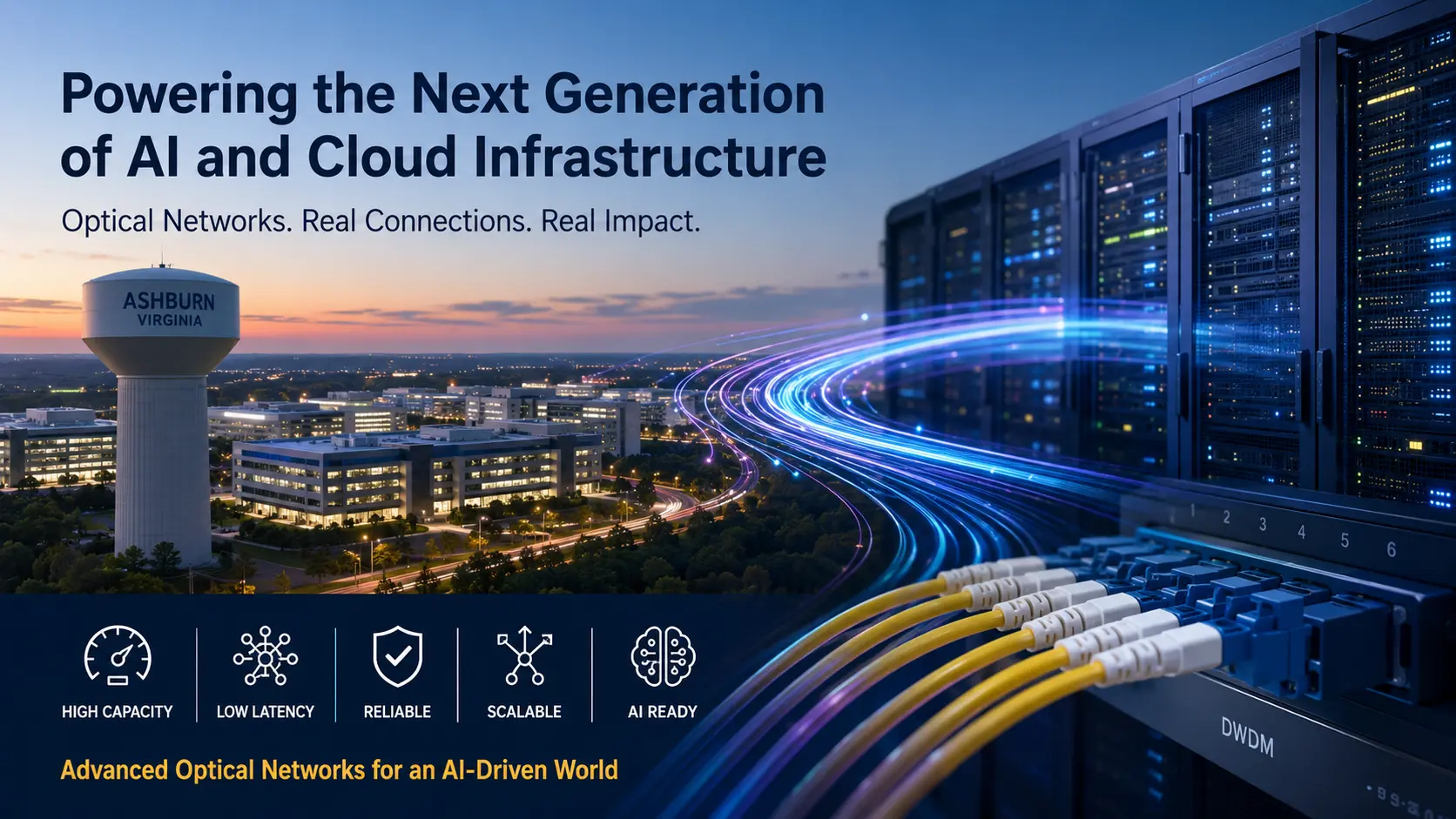
23 Jun Ashburn’s AI Data Center Boom Is Creating Urgent Need for Optical Networking Skills
For more than two decades, Ashburn, Virginia, has been recognized as the world’s leading concentration of data centers. Often referred to as Data Center Alley, the region handles a significant portion of the world’s Internet traffic and serves as the backbone for cloud computing, content delivery, enterprise networking, and hyperscale services.
Today, a new wave of investment is reshaping the region. Artificial intelligence (AI), high-performance computing (HPC), and cloud expansion are driving unprecedented demand for new data center capacity. Recent announcements illustrate the scale of this growth. STACK Infrastructure is developing a new 144 MW hyperscale campus in Loudoun County designed specifically for AI and machine learning workloads, while Sabey Data Centers has begun construction of the final phase of its Ashburn campus, supporting high-density deployments exceeding 100 kW per rack. More recently, Cologix announced the acquisition of 38 acres in the heart of Ashburn to expand its AI-ready interconnection infrastructure and support future hyperscale growth.
These projects are about far more than constructing additional buildings. They represent a fundamental transformation in the underlying communications infrastructure required to support AI. As GPU clusters become larger and applications demand ever-lower latency, optical communications has become as critical to data center performance as power and cooling.
AI Is Driving a Revolution in Optical Communications
The rapid deployment of AI infrastructure is dramatically increasing the amount of traffic flowing within and between data centers. Training large language models and supporting AI inference generate enormous volumes of east-west traffic between thousands of GPUs, requiring networks capable of moving terabits of data with minimal latency.
Meeting these demands requires far more than installing additional fiber. Modern AI data centers rely on sophisticated optical transport technologies, including:
- High-speed optical transceivers operating at 400G, 800G and emerging 1.6 Tb/s rates
- Dense Wavelength Division Multiplexing (DWDM) to maximize fiber capacity
- Coherent optics for metro and long-haul Data Center Interconnects (DCIs)
- Colorless, Directionless and Contentionless (CDC) ROADMs for flexible optical routing
- Software-defined optical networking and automated provisioning
- AI-assisted network monitoring and predictive maintenance
As hyperscale campuses continue to expand across Northern Virginia, the optical transport network has become the invisible engine connecting AI clusters, cloud regions, enterprise networks and global Internet infrastructure.
Optical Networks Are Becoming Increasingly Complex
Optical networking has undergone a remarkable transformation over the past decade. What was once a relatively straightforward point-to-point fiber connection has evolved into an intelligent, software-controlled transport platform supporting massive bandwidth demands.
Network capacity has progressed rapidly from 10G to 40G, 100G, 400G and 800G, with 1.6 Tb/s and even 3.2 Tb/s technologies already on the horizon. These advances are being enabled by higher baud rates, advanced coherent modulation formats, powerful digital signal processors (DSPs), flexible-grid DWDM systems and next-generation optical amplifiers.
As a result, today’s optical network engineers must understand far more than fiber connectivity. They must design, deploy and troubleshoot highly sophisticated transport networks that serve AI clusters, metro networks and global cloud infrastructures.
The Optical Networking Skills Gap Is Growing
While many IT professionals possess strong IP networking skills, far fewer have a deep understanding of optical communications. This shortage is becoming increasingly apparent as organizations deploy more advanced transport technologies.
Modern optical engineers are expected to understand topics such as:
- Fiber optic transmission fundamentals
- Optical power budgets
- Optical Signal-to-Noise Ratio (OSNR)
- Nonlinear fiber effects
- Coherent detection
- Advanced modulation formats
- Optical amplifiers
- DWDM system design
- ROADM architecture
- Optical transceiver technologies
- Data Center Interconnect (DCI) design
The growing complexity of optical transport means that organizations can no longer rely solely on vendor-specific product training. Instead, engineers need a strong vendor-neutral foundation that enables them to evaluate technologies, troubleshoot complex networks and make informed design decisions regardless of equipment manufacturer.
Why Vendor-Neutral Optical Networking Training Matters
As technologies such as 400ZR, 800ZR, coherent pluggables, open optical networking and software-defined transport become mainstream, continuous professional development has become essential.
Organizations that invest in optical networking education gain more than technical knowledge. They improve network reliability, reduce deployment risks, accelerate troubleshooting and prepare their teams for future technologies. In an industry evolving as rapidly as optical communications, upskilling is no longer optional—it is a strategic investment.
FiberGuide Brings Optical Networking Training to Ashburn
Recognizing the growing demand for optical networking expertise in Ashburn, FiberGuide is expanding its public training program to support Ashburn optical networking skills, placing industry-leading education in the heart of the world’s largest data center ecosystem.
The Certified Optical Network Associate (CONA) course provides a comprehensive introduction to optical communications for network engineers, project managers, systems integrators, technical sales professionals and operations personnel. Participants develop a solid understanding of fiber optics, CWDM, DWDM, optical transceivers, amplification and optical network architectures.
For experienced professionals, the Certified Optical Network Engineer (CONE) program explores the technologies shaping modern transport networks, including coherent optics, digital signal processors, advanced modulation formats, flex-grid DWDM, CDC ROADMs, Data Center Interconnects and AI-ready optical transport networks.
Both programs emphasize vendor-neutral principles and practical engineering knowledge that participants can immediately apply in real-world deployments.
Preparing for the Future of Digital Infrastructure
Artificial intelligence is reshaping every aspect of digital infrastructure. As hyperscale campuses continue to expand, optical communications will play an increasingly central role in enabling higher bandwidth, lower latency and greater network scalability.
The organizations that succeed in this new era will be those that invest not only in fiber, transceivers and network equipment, but also in the engineers who design, operate and optimize these increasingly sophisticated optical networks.
FiberGuide’s CONA and CONE training programs are designed to help bridge this growing skills gap by equipping professionals with the knowledge required to support the next generation of AI, cloud and high-capacity optical transport networks.
If your organization is preparing for the future of digital infrastructure, there has never been a better time—or a better place—to build your optical networking expertise than in Ashburn, Virginia.

Jabulani Dhliwayo is Founder and Technical Director of FiberGuide, a lecturer, scientist, engineer, and optical networking expert with more than 30 years of experience in fiber optics, telecommunications, research, and product development. He develops and delivers advanced CONA and CONE training programs for telecom operators, data centers, and government organizations. His career includes senior technical and product leadership roles at Corning and Yokogawa. His expertise spans DWDM, OTN, coherent optics, ROADMs, and fiber characterization. Dr. Dhliwayo holds a Ph.D. in Physics from the University of Kent, an M.S. in Applied Physics, and a B.S. in Physics.
You can connect with him on Linkedin
Sorry, the comment form is closed at this time.