

29 Dec Cloud Connectivity: How to Connect Your Business to the Cloud
Cloud Connectivity: Internet, Ethernet & Private Cloud Connections
Understanding the network services that connect businesses to AWS, Azure, Google Cloud, and modern cloud infrastructure
Cloud computing has transformed how businesses access applications, storage, computing resources, and data. Instead of maintaining all IT infrastructure in an on-premises data center, organizations can use cloud services from providers such as Amazon Web Services (AWS), Microsoft Azure, and Google Cloud.
But moving applications and data to the cloud creates another important requirement: cloud connectivity.
For businesses running mission-critical applications in the cloud, simply having an Internet connection may not be enough. Organizations increasingly need connectivity that provides predictable bandwidth, low latency, reliability, security, and scalability.
This is where dedicated Internet, Ethernet, private networks, and cloud interconnection services become important.
What Is Cloud Connectivity?
Cloud connectivity refers to the network infrastructure and services used to connect an organization's offices, data centers, users, and applications to cloud platforms.
There are several ways to connect to cloud services, ranging from ordinary broadband Internet to dedicated Internet access and private cloud connections.
The appropriate solution depends on bandwidth requirements, application performance, security, geographic availability, redundancy, and cost.
Internet vs. Dedicated Cloud Connectivity
For many users, ordinary broadband Internet remains an effective way to access cloud-based applications such as email, collaboration platforms, web applications, and other Software as a Service (SaaS) applications.
However, business-critical applications can have substantially greater networking requirements.
Mass-market broadband is generally a shared service. Actual performance can vary because capacity is shared among multiple subscribers. A business that depends on consistent network performance may therefore prefer dedicated Internet access.
Dedicated Internet provides a connection intended for a single customer and is normally delivered with a Service Level Agreement (SLA). Depending on the provider and service, the SLA may address availability, bandwidth, latency, packet loss, and other performance characteristics.
Dedicated Internet is particularly useful for applications such as cloud-based enterprise systems, video conferencing, large-scale data transfers, remote operations, and hybrid-cloud environments.
Ethernet and Cloud Connectivity
Ethernet has become the dominant technology for high-capacity enterprise connectivity because it is scalable, widely supported, and integrates naturally with existing LAN infrastructure.
Modern Ethernet services are no longer limited to the relatively low speeds associated with legacy T1/E1 services. Network providers can offer connectivity ranging from hundreds of megabits per second to 10, 100 Gbps and beyond, depending on location and service type.
For cloud connectivity, Ethernet may be delivered over fiber from a customer site to an Internet service provider, carrier network, data center, cloud on-ramp, or colocation facility.
Fiber-based connectivity is particularly important as organizations increase bandwidth to support cloud applications, artificial intelligence workloads, data-intensive applications, and hybrid-cloud architectures.
Private Cloud Connectivity
Organizations with demanding performance, security, or compliance requirements may choose a private connection to a cloud provider rather than sending traffic across the public Internet.
The major cloud providers offer their own private connectivity services.
AWS Direct Connect provides dedicated or hosted connectivity between customer networks and AWS. Dedicated connections are currently available at 1, 10, 100, and 400 Gbps, while hosted connections provide additional bandwidth options through Direct Connect Partners.
Microsoft Azure ExpressRoute provides private connectivity between on-premises infrastructure and Microsoft cloud services without traversing the public Internet. ExpressRoute Direct supports dual 10-, 100-, or 400-Gbps connectivity for large-scale deployments.
Google Cloud Interconnect provides dedicated or partner-based connectivity to Google Cloud. Dedicated Interconnect uses Ethernet circuits and supports 10-, 100-, and 400-Gbps circuit capacities. Multiple circuits can be combined to provide substantially greater aggregate bandwidth.
These services are particularly attractive for organizations that need predictable performance and direct connectivity to cloud infrastructure.
Advantages of Private Cloud Connectivity
Private cloud connectivity can provide several important advantages:
Predictable performance: Dedicated connections provide controlled network capacity and avoid many of the variable conditions associated with public Internet paths.
Lower and more consistent latency: Private connections can reduce the number of network hops and provide more predictable paths to cloud infrastructure. Google Cloud, for example, notes that Interconnect traffic does not traverse the public Internet.
Scalability: Modern Ethernet-based services can scale from relatively modest bandwidth to hundreds of gigabits per second.
Security: Private connectivity keeps traffic off the public Internet, although organizations should still implement appropriate network security, encryption, segmentation, and access controls. Private connectivity should not be confused with automatic end-to-end security.
Redundancy: Mission-critical cloud connectivity can be engineered with diverse physical paths, multiple connections, and redundant network equipment.
Cloud Connectivity Through a Carrier
Businesses do not necessarily have to establish a direct physical connection to every cloud provider.
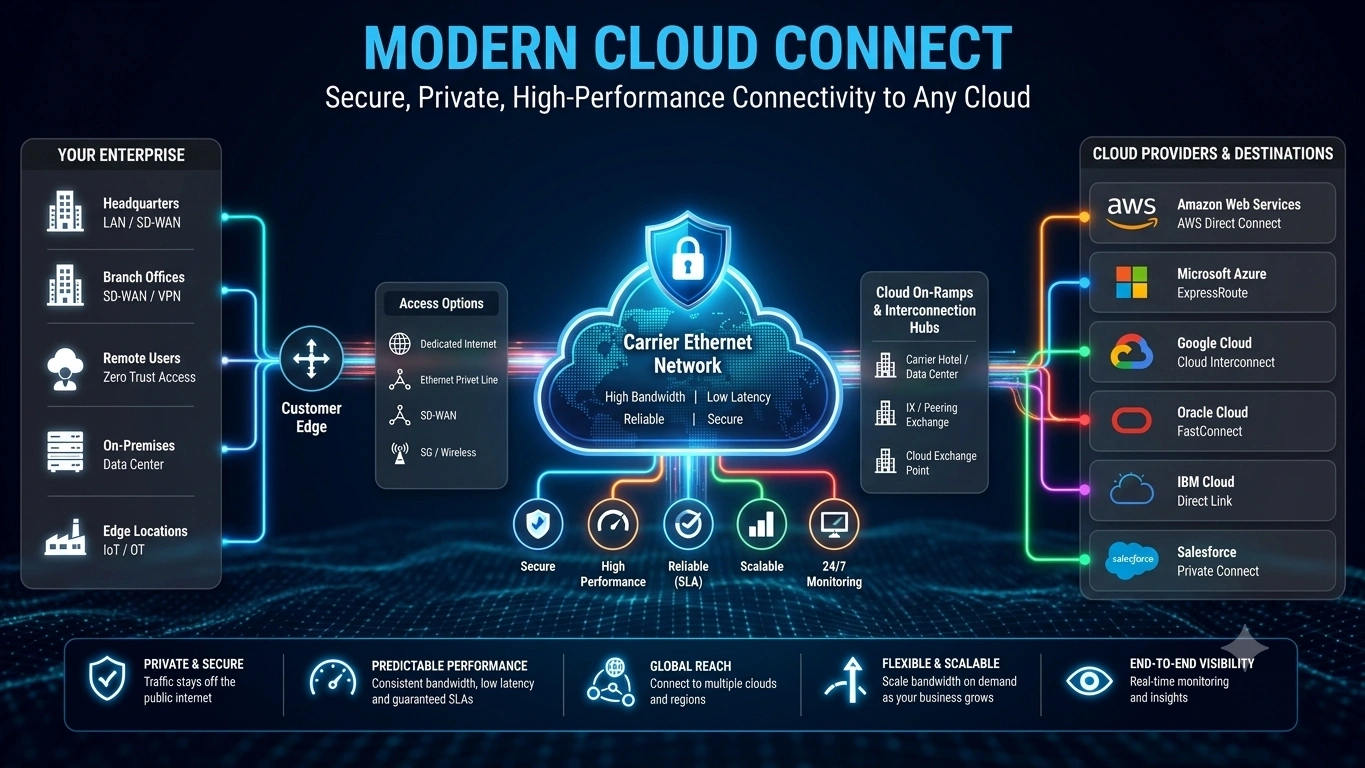
A carrier or connectivity provider can provide an Ethernet connection from the customer's premises to a cloud on-ramp, data center, or interconnection facility. This allows the customer to use existing network infrastructure to reach multiple cloud platforms.
Carrier Ethernet services, Ethernet Private Lines, Internet access, wavelengths, and other optical networking services can therefore form an important part of a multi-cloud connectivity strategy.
For organizations using several cloud providers, this approach can simplify network management while providing scalable connectivity between offices, data centers, colocation facilities, and cloud platforms.
Choosing the Right Cloud Connectivity Solution
There is no single cloud connectivity solution that is appropriate for every organization.
Businesses should evaluate:
- Required bandwidth
- Latency requirements
- Availability and SLA requirements
- Security and compliance requirements
- Need for physical-path redundancy
- Geographic availability
- Number of cloud providers
- Current data center and WAN architecture
- Expected future growth
- Total networking cost
For smaller or less critical applications, broadband Internet may be sufficient. Dedicated Internet is a better choice when consistent Internet performance is important. For highly sensitive or mission-critical workloads, private cloud connectivity through Ethernet, carrier services, or a cloud provider's interconnection platform may provide a more appropriate architecture.
FiberGuide Cloud Connectivity Support
Choosing among Internet access, Ethernet, carrier services, cloud interconnection, and private network options can be complicated because availability and pricing vary by location and provider.
FiberGuide helps organizations evaluate cloud connectivity options based on their technical requirements, location, bandwidth, performance objectives, and budget.
By working with multiple network providers, FiberGuide can help identify appropriate connectivity solutions and assist customers through the provisioning process.
Whether you need dedicated Internet, Ethernet connectivity, private cloud connectivity, or high-capacity connections between data centers and cloud platforms, choosing the right network architecture is critical to building a reliable, scalable cloud strategy. Contact FiberGuide today to discuss your requirements and find the connectivity solution that best fits your needs.

Jabulani Dhliwayo is Founder and Technical Director of FiberGuide, a lecturer, scientist, engineer, and optical networking expert with more than 30 years of experience in fiber optics, telecommunications, research, and product development. He develops and delivers advanced CONA and CONE training programs for telecom operators, data centers, and government organizations. His career includes senior technical and product leadership roles at Corning and Yokogawa. His expertise spans DWDM, OTN, coherent optics, ROADMs, and fiber characterization. Dr. Dhliwayo holds a Ph.D. in Physics from the University of Kent, an M.S. in Applied Physics, and a B.S. in Physics.
You can connect with him on Linkedin
Sorry, the comment form is closed at this time.