

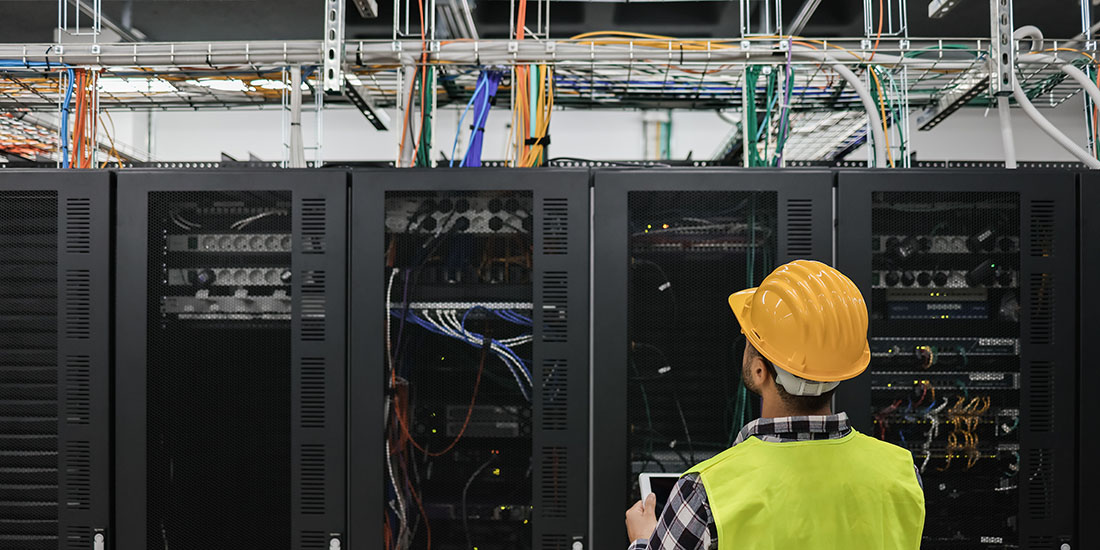
10 Nov The Future is Dense: Revolutionizing Data Centers with Fiber Optic Innovation
High-Density Data Centers: Fiber Connectivity for AI, 800G and 1.6T Networks
High-density data centers are entering a new phase. The original drivers—cloud computing, large-scale storage, virtualization and growing Internet traffic—remain important, but artificial intelligence is now accelerating the need for substantially more compute capacity, network bandwidth and fiber connectivity within the same physical footprint.
AI clusters can contain enormous numbers of GPUs and high-speed switches exchanging data across increasingly dense network fabrics. As link speeds progress from 100G and 400G toward 800G and 1.6T, data center designers must accommodate more bandwidth, more fibers, more ports and more power without allowing cabling complexity to become a limiting factor.
That makes the physical optical infrastructure increasingly important. High-density pre-terminated cable assemblies, Very Small Form Factor (VSFF) connectors, reduced-diameter fiber, MPO connectivity, OSFP and QSFP-DD transceivers, and new optical architectures are all helping data centers increase capacity while controlling space, power and operational complexity.
Table of Contents
- Why Data Centers Are Becoming More Dense
- AI Is Changing the Meaning of High Density
- High-Density Pre-Terminated Fiber Cabling
- VSFF Connectors: CS, SN and Next-Generation Connectivity
- Reduced-Diameter Fiber and Higher Fiber Counts
- From SFPs to 800G and 1.6T Pluggable Optics
- Power, Cooling and Optical Density
- Example: Legrand Infinium acclAIM
- Designing the Fiber Layer for High-Density Data Centers
- The Future of High-Density Data Center Connectivity
1. Why Data Centers Are Becoming More Dense
The basic economic pressure behind high-density data centers is straightforward: operators need to deliver more computing, storage and network capacity from expensive data center space.
Cloud services, streaming, enterprise applications, IoT, data analytics and increasingly AI workloads have driven continuous growth in traffic and compute demand. At the same time, available floor space, electrical power, cooling capacity and fiber pathways impose practical constraints on expansion.
Rather than simply making facilities larger, operators are increasing the amount of useful compute and network capacity that can be supported per rack, row and data hall.
High density is not simply about putting more equipment in a rack. A successful design must consider compute density, switch capacity, optical port density, fiber count, cable pathways, power, cooling, maintainability and the ability to migrate to future network speeds.
2. AI Is Changing the Meaning of High Density
The growth of artificial intelligence has intensified the high-density challenge. Large AI clusters require huge amounts of communication between GPUs, network interface cards and switches. This creates extremely high-bandwidth east-west traffic inside the data center and high-capacity connections between data centers.
Modern AI fabrics are moving toward 800G interfaces, while 1.6T pluggable optics are emerging for next-generation switch-to-server and switch-to-switch connectivity. Higher switch capacities also mean that a single rack or network row can terminate far more aggregate bandwidth than was practical only a few years ago.
| Network Generation | Typical Optical Environment | Physical-Layer Challenge |
|---|---|---|
| 100G | Enterprise, cloud and earlier hyperscale fabrics | Higher port counts and structured fiber management |
| 400G | Hyperscale, cloud, spine/leaf and DCI | Greater fiber density, MPO/parallel optics and higher-power modules |
| 800G | AI/ML clusters and next-generation data center fabrics | Very high port density, thermal management and dense optical connectivity |
| 1.6T | Emerging AI scale-out and high-capacity fabrics | 200G-per-lane technology, higher thermal loads and even denser fiber infrastructure |
The result is a convergence of network architecture and physical infrastructure. The optical connector, cable diameter, fiber count and transceiver form factor can directly influence how efficiently the network can scale.
3. High-Density Pre-Terminated Fiber Cabling
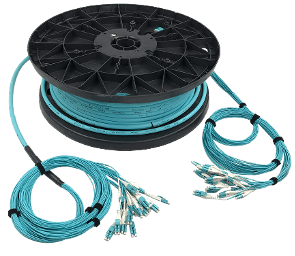
High-density pre-terminated cable assemblies remain an important part of modern data center design. Instead of terminating large numbers of fibers in the field, assemblies are manufactured and tested before they arrive at the data center.
This approach can reduce installation time, improve consistency and make large fiber deployments easier to plan. In environments where hundreds or thousands of fiber connections must be installed within limited maintenance windows, these advantages become increasingly important.
Pre-terminated systems can provide:
- Faster deployment
- Factory-tested optical performance
- Reduced field termination
- Predictable polarity and connector configuration
- Modular expansion
- Higher connection density
- Cleaner cable pathways
Modularity is particularly valuable in AI and hyperscale facilities because network architectures evolve quickly. Structured cabling must support equipment replacement, breakout configurations and migration to higher interface speeds without requiring the entire physical layer to be rebuilt.
4. VSFF Connectors: CS, SN and Next-Generation Connectivity
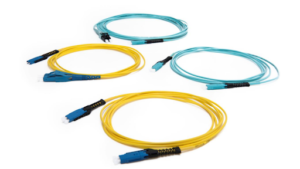
As port density increases, the physical size of the fiber connector becomes increasingly important. Very Small Form Factor (VSFF) connectors were developed to provide more optical connections in less space than traditional duplex connector formats.
The CS connector provides a smaller duplex footprint than the traditional LC and can support high-density patching and transceiver applications. The SN connector provides an even more compact duplex format and is increasingly associated with high-density 400G, 800G and next-generation optical connectivity.
VSFF interfaces can help designers increase patch-panel and equipment density while retaining duplex fiber connectivity. Newer multi-fiber VSFF approaches extend this concept further for high-count trunk and transceiver applications.
The density challenge has shifted. In earlier data centers, the question was often how many LC or MPO connections could fit in a rack. With 800G and 1.6T systems, designers increasingly evaluate the entire connectivity ecosystem—including VSFF interfaces, breakout options, fiber counts, patch-panel density and transceiver faceplate space.
5. Reduced-Diameter Fiber and Higher Fiber Counts
Increasing fiber density is not limited to smaller connectors. Fiber and cable manufacturers have also reduced the diameter of coatings and cable structures so that more fibers can occupy a given pathway.
Conventional telecommunications single-mode fiber typically uses 125-micron glass cladding with a larger protective coating. High-density cable designs can use reduced coating diameters, such as approximately 200 microns, to increase the number of fibers that can be placed within a cable while reducing overall cable diameter.
Specialized reduced-cladding fibers can go further, but they should not be treated as interchangeable with conventional 125-micron infrastructure. Connectorization, splicing, handling and compatibility must all be considered as part of the system design.
For high-density data centers, the broader objective is straightforward: increase usable fiber count without allowing cable pathways, trays and conduits to become unmanageable.
Potential benefits include:
- More fibers within existing pathways
- Smaller trunk-cable diameters
- Reduced cable weight
- Improved pathway utilization
- Potential material savings
- Greater capacity for future network growth
6. From SFPs to 800G and 1.6T Pluggable Optics

The original small form factor pluggable revolution was driven by SFP and later SFP+ modules. SFP28 extended this family to 25G applications, while QSFP28 became an important form factor for 100G.
Today's high-density data centers have moved substantially beyond those generations. QSFP-DD and OSFP now play major roles in 400G and 800G systems, while OSFP is also an important platform for emerging 1.6T connectivity.
| Form Factor | Common Network Speeds | Typical Role |
|---|---|---|
| SFP28 | 25G | Server and switch connectivity |
| QSFP28 | 100G | Data center and transport networking |
| QSFP-DD | 400G / 800G | High-density switching and data center optics |
| OSFP | 400G / 800G / emerging 1.6T | AI fabrics and high-power, high-capacity optical interfaces |
The significance of modern pluggables extends beyond speed. The transceiver determines fiber count, connector type, breakout architecture, reach, power consumption and thermal requirements.
For short-reach data center links, direct-detection PAM4 optics remain important. For longer connections and data center interconnect, coherent pluggables such as ZR and ZR+ bring coherent transmission into compact router and switch interfaces.
7. Power, Cooling and Optical Density
As data rates and port counts increase, density cannot be considered independently from power and cooling. Higher-speed transceivers and switch ASICs create substantial thermal loads, particularly in AI clusters where large numbers of high-capacity ports may be concentrated in a small area.
This is one reason the industry is exploring technologies such as Linear Pluggable Optics (LPO) and Co-Packaged Optics (CPO). Both seek, in different ways, to reduce the electrical power and signal-integrity challenges associated with moving extremely high-speed electrical signals between switch silicon and optical interfaces.
High-density cabling can also affect airflow and serviceability. A design that maximizes the theoretical number of fibers in a rack but makes equipment difficult to cool, inspect or replace is not necessarily an effective high-density design.
High density must remain operationally manageable. Fiber density, bend radius, connector accessibility, airflow, transceiver cooling, labeling and moves/adds/changes should be evaluated together rather than as separate design problems.
8. Example: Legrand Infinium acclAIM
One example from the original high-density connectivity discussion is Legrand's Infinium acclAIM. The system was developed to simplify high-density fiber deployment by reducing reliance on traditional cassette-based architectures and supporting direct-mating breakout connectivity.
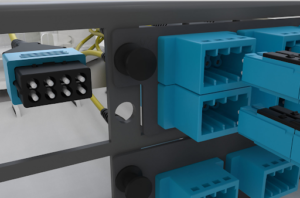
Direct-Mating Breakout
The direct-mating approach is designed to reduce intermediate connection points and simplify the relationship between trunk cabling and duplex patch connections. Fewer components can simplify installation and potentially reduce optical loss and troubleshooting complexity.
Application-Defined Polarity
Polarity remains a critical consideration in pre-terminated and high-density fiber systems. Architectures that make polarity easier to configure and manage can simplify migrations, moves and upgrades.
Installation Efficiency
The broader lesson from systems such as acclAIM is not limited to one product: modern data centers increasingly favor connectivity architectures that reduce installation steps, simplify testing and allow infrastructure to be reconfigured as network speeds and equipment change.
9. Designing the Fiber Layer for High-Density Data Centers
The fiber layer should be planned as infrastructure rather than as an afterthought to the switches and servers. A high-density design needs to support today's network while preserving realistic migration paths for future optics.
Important considerations include:
- Fiber type: multimode versus single-mode requirements and expected reach
- Connector strategy: LC, MPO, CS, SN or other high-density interfaces
- Transceiver roadmap: 100G, 400G, 800G and 1.6T migration requirements
- Breakout architecture: how higher-speed ports will connect to lower-speed endpoints
- Fiber count: sufficient capacity for growth and redundancy
- Pathways: tray, conduit and rack capacity for increasing cable density
- Loss budget: connector, splice and fiber attenuation across the channel
- Polarity: especially for multi-fiber and pre-terminated systems
- Inspection and cleaning: critical as connector density increases
- Documentation: accurate labeling and records for thousands of optical connections
These issues become even more important as data centers connect to metro and long-haul optical networks. High-density intra-data-center fiber, wavelength services, dark fiber and coherent DCI increasingly form parts of the same end-to-end connectivity strategy.
10. The Future of High-Density Data Center Connectivity
High-density data centers will continue to evolve as AI clusters grow and network interfaces progress from 800G to 1.6T and eventually beyond. Simply installing more fibers is unlikely to be enough.
Future designs will combine multiple approaches: smaller connectors, higher-fiber-count trunks, reduced-diameter cabling, more efficient pluggable optics, silicon photonics, LPO, CPO and increasingly integrated optical architectures.
The underlying goal remains the same: move more data through a limited amount of space while controlling power, cooling, complexity and cost.
This makes fiber infrastructure a strategic part of data center architecture. Decisions about cabling, connectors and optical interfaces made today can determine how easily a facility can migrate to tomorrow's network speeds.
Build the Optical Networking Skills Behind High-Density Data Centers
High-density AI and cloud data centers depend on more than cabling. Engineers working with these environments increasingly need to understand fiber characteristics, optical power budgets, transceivers, CWDM/DWDM, impairments, coherent optics and the relationship between the physical fiber layer and high-capacity optical networks.
FiberGuide's vendor-neutral CONA and CONE certification programs provide a structured path from optical networking fundamentals to advanced high-capacity coherent systems.
CONA — Build the Optical Networking Foundation
Certified Optical Network Associate (CONA) covers fiber optics, optical components, attenuation and power budgets, CWDM, DWDM, optical amplifiers, impairments, direct-detection systems and optical network design.
It is suited to engineers, technicians, data center professionals, network planners and others who need a solid understanding of how optical networks work.
Explore CONACONE — Advance into Coherent and High-Capacity Networks
Certified Optical Network Engineer (CONE) advances into coherent detection, DSP, modulation formats, ROADMs, Flexgrid DWDM, coherent pluggables, 400G/800G systems, optical impairments and modern high-capacity network architectures.
It is designed for experienced professionals involved in optical network engineering, planning, design, DCI and architecture.
Explore CONEPrepare Your Team for the Next Generation of Optical Infrastructure
Explore upcoming FiberGuide CONA and CONE classes or contact us about private optical networking training for data center, telecommunications and network engineering teams.
View Training Schedule
Jabulani Dhliwayo is Founder and Technical Director of FiberGuide, a lecturer, scientist, engineer, and optical networking expert with more than 30 years of experience in fiber optics, telecommunications, research, and product development. He develops and delivers advanced CONA and CONE training programs for telecom operators, data centers, and government organizations. His career includes senior technical and product leadership roles at Corning and Yokogawa. His expertise spans DWDM, OTN, coherent optics, ROADMs, and fiber characterization. Dr. Dhliwayo holds a Ph.D. in Physics from the University of Kent, an M.S. in Applied Physics, and a B.S. in Physics.
You can connect with him on Linkedin
Sorry, the comment form is closed at this time.