

25 Feb Broadband Internet Options
Broadband Internet: Understanding DSL, Cable, Fiber, Mobile, and Satellite Options
In today’s hyper-connected world, the demand for high-speed broadband internet is skyrocketing. From powering AI applications and 5G networks to streaming movies and supporting cloud computing, internet connectivity has become essential for work, education, and entertainment. As a result, understanding the various broadband internet options is more important than ever. This guide covers DSL, cable or hybrid fiber-coaxial (HFC), fiber to the home (FTTH), mobile broadband, and satellite internet—including geostationary (GEO) and low Earth orbit (LEO) options—explaining infrastructure, equipment, speeds, and key considerations for each type.
________________________________________
What Is Broadband Internet?
Broadband internet generally refers to high-speed internet connectivity capable of supporting multiple devices and high-bandwidth applications. In the United States, the Federal Communications Commission (FCC) defines broadband as internet service with a minimum of 25 Mbps download and 3 Mbps upload speeds.
Choosing the right broadband service depends on availability, user needs, and budget. For instance, someone in a remote area of Zimbabwe may only access expensive satellite broadband or unreliable mobile networks, whereas residents in Kansas City, USA, can choose from multiple options, including fiber to the home with speeds up to 20 Gbps from providers like Google Fiber.
________________________________________
1. Digital Subscriber Line (DSL)
DSL transmits internet data over twisted copper telephone lines, offering faster speeds than traditional dial-up by using higher frequency bands. A DSL splitter separates phone and internet signals, and a DSL modem connects the service to your router or computer.
Common DSL types:
• ADSL (Asymmetric DSL): Offers faster download than upload speeds.
• SDSL (Symmetric DSL): Provides equal download and upload speeds.
• VDSL (Very High Bitrate DSL): Uses fiber to the node (FTTN) to bring fiber closer to homes, then copper to the premises, achieving speeds up to 400 Mbps, with performance decreasing over longer copper distances.
• G.fast: A newer DSL standard designed to deliver gigabit speeds over very short copper lines, ideal for densely populated neighborhoods.
Major DSL providers include AT&T and Verizon in the U.S., British Telecom in the UK, and Telkom in South Africa.
________________________________________
2. Cable or Hybrid Fiber-Coaxial (HFC) Internet
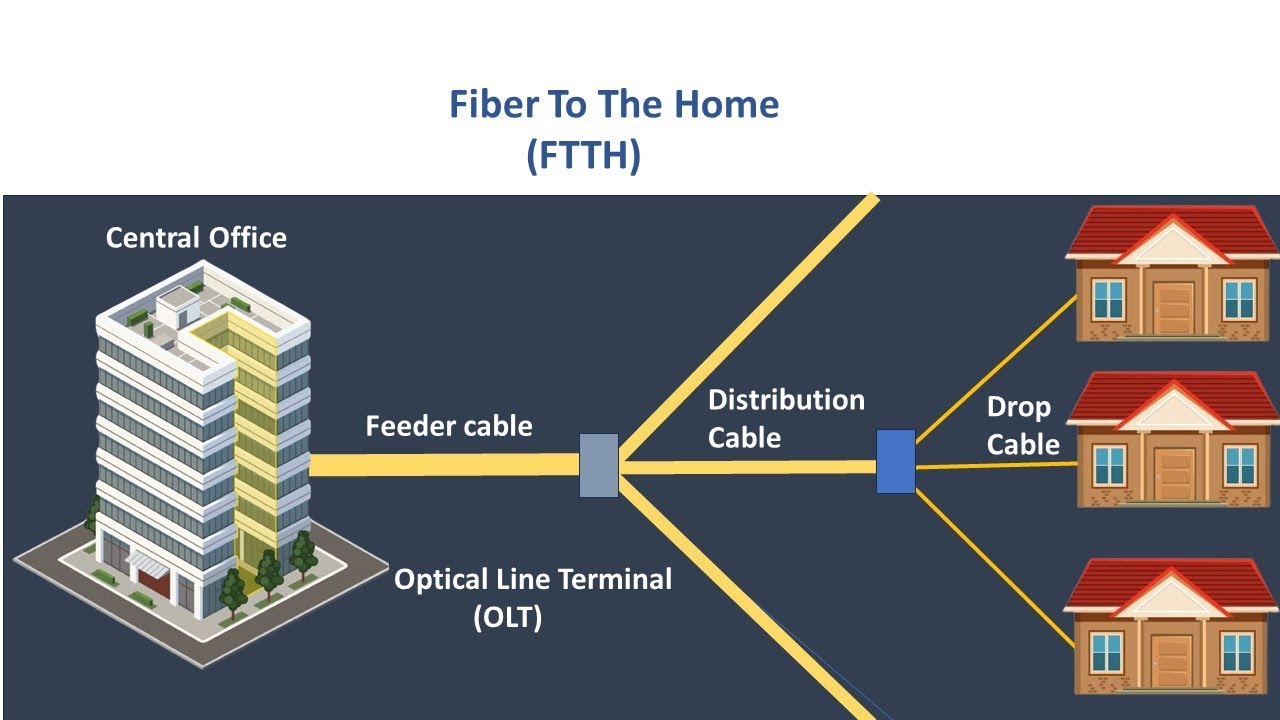
Cable broadband leverages existing cable TV infrastructure, combining fiber optic backbones with coaxial connections to homes. Modern HFC networks deploy fiber from the provider’s central office to neighborhood nodes, with coaxial cable completing the connection to residences.
Equipment Required:
• Cable modem connected to a router or directly to a computer via Ethernet.
Speeds:
• Cable internet often outperforms DSL, offering gigabit speeds in many urban areas.
• Upload speeds may lag behind downloads, especially on shared networks.
Major cable internet providers in the U.S. include Comcast Xfinity, Spectrum (formerly Time Warner Cable), and Cox Communications.
________________________________________
3. Fiber to the Home (FTTH)
FTTH delivers fiber optic connectivity directly to residences, providing unparalleled speeds, low latency, and reliability. A fiber optic network terminal (ONT) interfaces your home with the provider’s optical network, connecting to a router for device distribution.
Advantages:
• Gigabit speeds are common, with 10–20 Gbps becoming available in select areas as of 2024.
• Ideal for high-demand applications such as streaming, gaming, teleconferencing, and cloud computing.
Limitations:
• Expensive infrastructure limits deployment mainly to urban or suburban areas. Rural access is often minimal or unavailable.
Providers offering FTTH include Google Fiber, Verizon Fios, AT&T Fiber, and EPB Fiber in Chattanooga, TN.
________________________________________
4. Mobile Broadband Internet
Mobile networks provide internet via cellular towers, covering users on the move or in areas without wired connections. Access is achieved through smartphones, USB dongles, or mobile hotspots.
Factors Affecting Speeds:
• Distance to the nearest cell tower
• Network congestion
• Mobile network generation: 2G, 3G, 4G LTE, or 5G
Typical Speeds:
• 4G LTE: 12–35 Mbps average; theoretical max up to 1 Gbps.
• 5G: 100–300 Mbps average; potential up to 20 Gbps under ideal conditions.
Top U.S. providers include Verizon, AT&T, T-Mobile, and Sprint (now part of T-Mobile).
________________________________________
5. Satellite Internet
Satellite broadband is ideal for remote areas, maritime, or aerial connectivity, using either geostationary (GEO) or low Earth orbit (LEO) satellites.
Geostationary (GEO) Satellites
• Orbit ~36,000 km above Earth, appearing stationary relative to a location.
• Requires a satellite dish and modem.
• Speeds: up to 150 Mbps, with higher latency (~500 ms round trip).
• Providers: HughesNet, Viasat.
Low Earth Orbit (LEO) Satellites
• Orbit ~2,000 km, completing ~16 orbits per day.
• Faster, lower latency internet due to proximity.
• Providers: SpaceX Starlink uses thousands of interconnected satellites and self-orienting phased-array antennas to maintain continuous coverage.
• Speeds: up to 300 Mbps with various subscription plans.
Equipment Costs:
• Starlink: ~$600 for the satellite kit in the U.S.
• Monthly fees vary depending on speed and data allowances.
LEO satellites are revolutionizing remote internet access, making high-speed broadband feasible even in isolated regions.
________________________________________
Choosing the Right Broadband Internet
When selecting a broadband provider, consider:
• Availability: Check what services are offered in your area.
• Speed Requirements: Factor in your usage—streaming, gaming, work from home, or enterprise needs.
• Cost: Compare monthly fees, installation, and equipment charges.
• Reliability: Fiber and cable networks generally offer the most stable connections; mobile and satellite can vary with weather and congestion.
For rural or underserved regions, satellite or mobile broadband may be the only viable options. Urban areas often have multiple choices, including fiber, cable, and DSL.
________________________________________
Conclusion
Broadband internet has evolved significantly, from copper-based DSL to ultra-fast fiber optics and global satellite networks. Understanding the differences in infrastructure, speeds, and equipment helps consumers, businesses, and policymakers make informed decisions.
Whether you are streaming entertainment, building a smart city network, or working remotely, selecting the right broadband service ensures reliable, high-speed connectivity. For those interested in networking careers or optical communications, gaining knowledge in FTTH, DSL, HFC, and satellite technologies can provide a strong foundation for entering the broadband and telecom industry.
If you want to strengthen your skills in optical networking and broadband infrastructure, consider certifications such as Certified Optical Network Associate (CONA) or Certified Optical Network Engineer (CONE) from providers like FiberGuide and OTT.

Founder and Technical Director at FiberGuide, Lecturer, Scientist and Engineer. Passionate about optical networking and information and communication technologies. Connect with me on Linkedin – https://www.linkedin.com/in/jabulani-dhliwayo-1570b5b
Sorry, the comment form is closed at this time.