

08 Jan Short-Reach Data Center Optics: Why 220/224 Gbaud Pluggables and OSFP-XD Are Driving the Next Generation of High-Speed Networks
Modern data centers are under constant pressure to scale bandwidth, reduce latency, and support the explosive growth of AI, machine learning, and cloud applications. At the heart of this evolution are modular pluggable optical transceivers, which convert high-speed electrical signals from switches, routers, and accelerators into optical signals that travel over fiber—and back again at the receiver. In short-reach data center environments, where east–west traffic dominates, operators must carefully balance bandwidth density, power efficiency, cabling complexity, and cost, while keeping pace with the increasing demands of AI training, inference, and storage fabrics.
The Shift from Multimode to Single-Mode Fiber in Short-Reach Applications
Historically, short-reach links in data centers have relied on multimode fiber (MMF), primarily because of its lower cost and ease of deployment. However, as hyperscale operators scale their networks, they are increasingly moving toward single-mode fiber (SMF) for short-reach applications. Single-mode architecture such as DR4, DR8, and short-reach FR implementations—offer predictable attenuation, simplified fiber management, and easier scalability across the entire data center. This shift reduces operational complexity and provides a future-proof foundation as link speeds increase.
Parallel Optics: The Backbone of Short-Reach Data Center Connectivity
Parallel optics have been a cornerstone of short-reach data center designs for over a decade. Early 40 Gb/s transceivers relied on four parallel optical lanes, typically over multimode fiber. This simple design pattern enabled smooth evolution to 100 Gb/s, 400 Gb/s, and 800 Gb/s links, creating a foundation for today’s high-density short-reach networks.
At 800 Gb/s, parallel optics remain dominant. Widely deployed SR8 (multimode) and DR8 (single mode) modules use eight optical lanes, each carrying 100 Gb/s using PAM4 modulation at approximately 50 Gbaud. These architectures represent the practical upper limit of traditional short-reach parallel optics, balancing performance with manageable lane counts and fiber requirements.
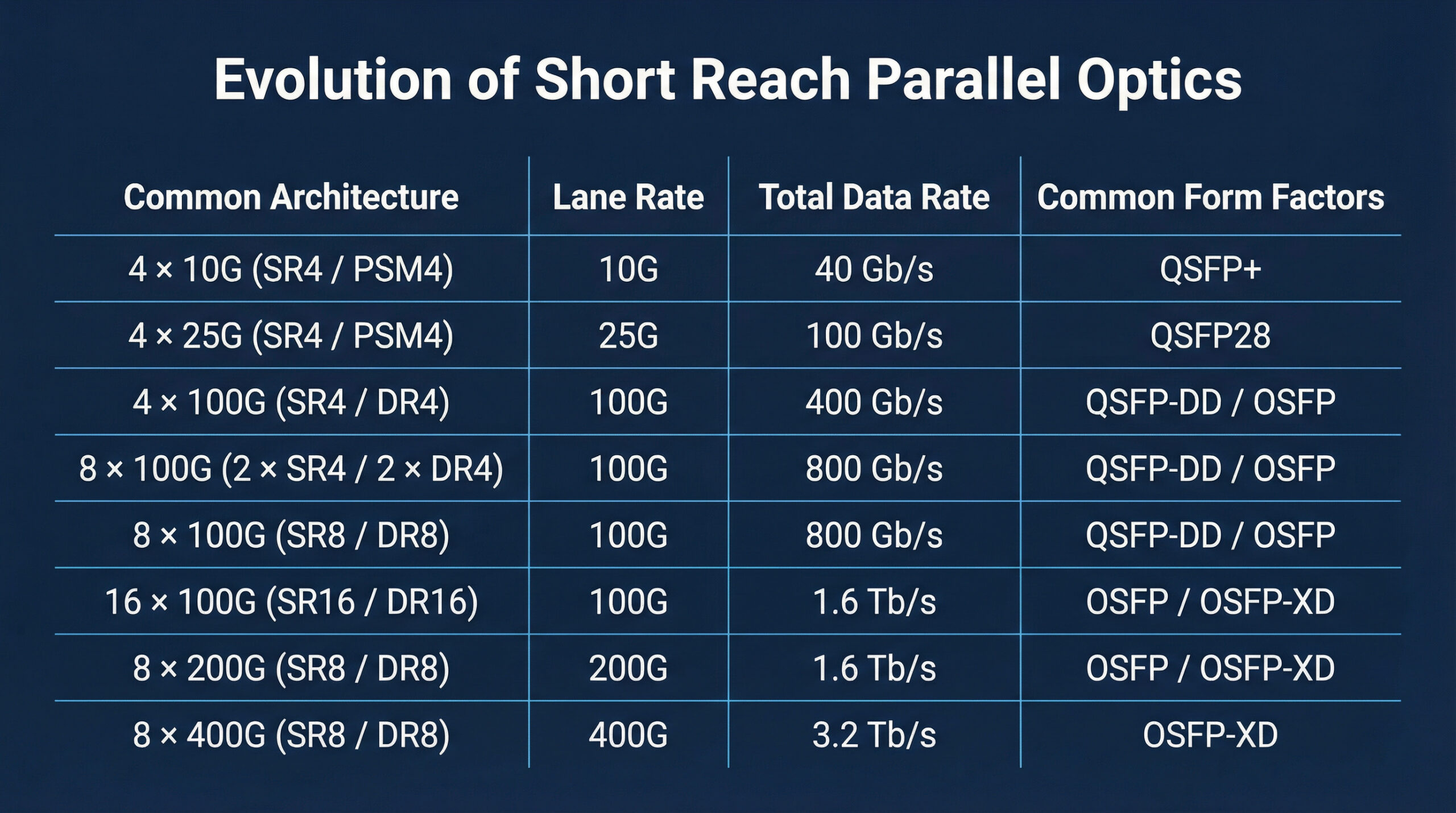
The table summarizing the evolution of short-reach parallel fiber architectures captures this progression clearly—from 4-lane 40 Gb/s modules, through 8-lane 800 Gb/s designs, to emerging 1.6 Tb/s and 3.2 Tb/s solutions. It highlights how increases in aggregate bandwidth were historically achieved by adding lanes, while newer generations increasingly rely on higher per-lane speeds.
Scaling to 1.6 Tb/s: Multiple Paths Enabled by OSFP-XD
As data centers push beyond 800 Gb/s, operators face two main architectural paths for 1.6 Tb/s short-reach modules:
1. Increasing Lane Count: Leveraging larger form factors such as OSFP and OSFP-XD, a 1.6 Tb/s module can use 16 optical lanes at 100 Gb/s per lane (~100 Gbaud). This approach is a near-term, lower-risk solution, building directly on mature 800 Gb/s designs. The trade-off is higher fiber counts and denser connector layouts.
2. Higher Baud Rates: By adopting 200–224 Gbaud signaling, a 1.6 Tb/s module can achieve the same total bandwidth with just eight optical lanes, significantly reducing fiber count and improving port density. This high-baud architecture also provides a direct path to 3.2 Tb/s, where eight lanes at ~400 Gb/s per lane deliver terabit-class throughput.
Why 220/224 Gbaud Signaling Matters for Short-Reach Data Center Links
Scaling purely by lane count becomes increasingly inefficient as speeds rise. More lanes mean more fibers, higher power consumption, tighter mechanical tolerances, and greater operational complexity. High-baud signaling offers a more scalable and efficient solution, increasing bandwidth per lane without linear growth in parallelism.
While moving from 50 Gbaud to 100 Gbaud supports 16-lane 1.6 Tb/s designs, 220/224 Gbaud represents a critical inflection point, enabling terabit-class pluggables without excessive fiber count. Achieving these speeds requires advances across SerDes, DSPs, optical modulators, lasers, and packaging, but the rewards in power efficiency, bandwidth density, and operational simplicity are substantial.
Progress and Industry Outlook
Recent demonstrations of 224 Gbaud PAM4 transmission at ~448 Gb/s per lane validate the feasibility of ultra-high-baud optics for short-reach applications. While early 1.6 Tb/s deployments may favor 16-lane 100 Gbaud designs for time-to-market reasons, 220/224 Gbaud technology is the foundation for future short-reach 1.6 Tb/s and 3.2 Tb/s modules. Hyperscalers transitioning from multimode to single-mode fiber can leverage these high-baud architectures to maximize port density and simplify operations.
The table summarizing parallel optics evolution provides a clear visual of this progression—from 40 Gb/s 4-lane modules to 16-lane 100 Gbaud OSFP-XD designs and high-baud 8-lane 200/224 Gbaud modules. It illustrates the shift from scaling by lane count to scaling by baud rate, highlighting why OSFP-XD and high-baud signaling are central to next-generation short-reach networks.
Conclusion
The evolution of short-reach data center optics is no longer defined by a single fiber type or architecture. OSFP-XD, combined with 200–224 Gbaud per-lane signaling, provides flexibility to deploy 1.6 Tb/s using either increased lane counts or higher per-lane speeds, while continuing the transition from multimode to single-mode fiber even at short distances. For operators, this dual-track approach balances immediate deployment practicality with long-term scalability, ensuring optical interconnects can meet the demands of AI-driven, east–west-heavy data center workloads.
To deepen your understanding of pluggable optical transceivers, parallel optics, short-reach data center architectures, and other areas of optical networking, explore OTT optical networking training programs offered by FiberGuide, including the Certified Optical Network Associate (CONA) and Certified Optical Network Engineer (CONE) courses.
Sorry, the comment form is closed at this time.