

22 Aug SWDM Explained: Enabling 40G & 100G Over Duplex Fiber — And Why It Doesn’t Scale to 1.6TbE
The continued growth of cloud computing, AI workloads, and high-bandwidth applications is driving relentless demand for higher data rates inside data centers and enterprise networks. As operators migrate from 10G and 40G to 100G, 400G, and beyond, cost-effective short-reach optical technologies remain essential.
Shortwave Wavelength Division Multiplexing (SWDM) emerged as an elegant solution for increasing capacity over existing multimode fiber (MMF) infrastructure — without requiring parallel ribbon fiber.
But how far can SWDM scale? And can it support emerging speeds like 800G or 1.6TbE?
Let’s break it down.
What Is SWDM?
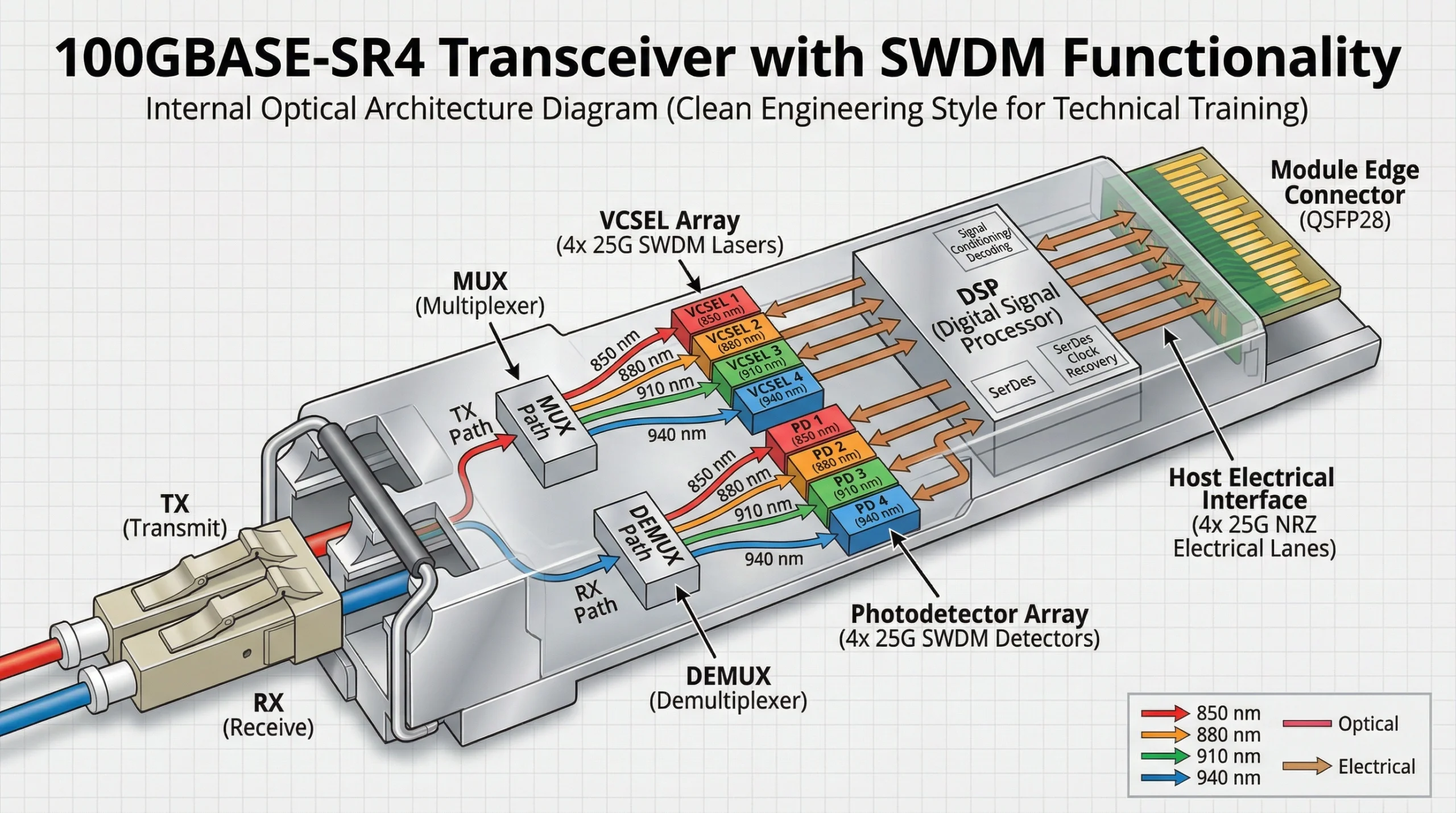
Shortwave Wavelength Division Multiplexing (SWDM) applies the same wavelength-division multiplexing concept used in CWDM systems — but at shorter wavelengths around 850 nm over multimode fiber.
Instead of transmitting a single signal over one wavelength, SWDM uses four wavelengths centered at:
- 850 nm
- 880 nm
- 910 nm
- 940 nm
With 30 nm spacing between channels.
This allows multiple signals to be transmitted over a single duplex MMF pair.
Typical Implementations
- 40Gbps = 10Gbps × 4 wavelengths
- 100Gbps = 25Gbps × 4 wavelengths
By multiplexing wavelengths rather than using multiple fiber pairs, SWDM enables higher data rates while preserving traditional duplex cabling.
Why SWDM Was Needed
Before SWDM, higher data rates in MMF systems relied on parallel optics.
The IEEE 802.3ba standard defined:
- 40GBASE-SR4 (10G × 4 fibers)
- 100GBASE-SR10 (10G × 10 fibers)
- 100GBASE-SR4 (25G × 4 fibers)
These implementations required 8, 10, or more fibers in each direction using ribbon cables (12f or 24f MPO assemblies).
This created several challenges:
- Existing OM3/OM4 duplex infrastructure had to be replaced
- Ribbon fiber introduced optical skew issues
- Fiber array alignment became critical
- Cabling complexity increased
SWDM addressed these issues by enabling 40G and 100G transmission over existing duplex MMF — significantly reducing upgrade costs.
The Role of VCSELs
The cost advantage of multimode systems comes from vertical-cavity surface-emitting lasers (VCSELs), which operate around 850 nm.
However, VCSELs have modulation speed limitations. Historically:
- 10G per lane was standard
- 25G per lane became widely adopted
- 50G per lane has been explored
- 100G per lane is extremely challenging for MMF
Rather than pushing single-lane speeds higher, SWDM multiplied capacity using multiple wavelengths.
OM5: Wideband Multimode Fiber
Traditional laser-optimized fibers (OM3 and OM4) are specified primarily at 850 nm.
To ensure adequate bandwidth across all SWDM wavelengths (850–940 nm), the TIA introduced Wideband MMF (TIA-492AAAE) in 2016.
ISO/IEC 11801 designated this as:
- OM5
OM5 guarantees effective modal bandwidth (EMB) and attenuation performance at both 850 nm and 953 nm, ensuring sufficient performance across the SWDM spectrum.
Can SWDM Scale to 400G?
Some proprietary and emerging designs have explored:
- 50G × 4 wavelengths = 200G
- 100G PAM4 × 4 wavelengths = 400G
However, modal dispersion, VCSEL modulation limits, and power constraints make scaling beyond 400G over duplex MMF increasingly difficult.
As speeds increase, single-mode fiber becomes more attractive due to:
- Lower dispersion
- Greater reach
- Better scalability
- Higher per-lane speeds
Can SWDM Support 800G or 1.6TbE?
This is where many engineers have questions.
The emerging IEEE 802.3dj standard is defining:
- 800GbE
- 1.6TbE
These architectures rely on:
- 100G or 200G PAM4 electrical lanes
- Parallel fiber designs
- Primarily single-mode fiber
There is currently no IEEE Ethernet standard that enables 1.6Tb/s using SWDM over multimode fiber.
Why?
Because reaching 1.6Tb/s would require:
- Extremely high per-wavelength data rates beyond current VCSEL capability, or
- A significantly larger number of wavelengths than the MMF shortwave spectrum can support
Multimode fiber modal bandwidth and VCSEL modulation limits make this impractical with current technology.
As networks move toward 800G and 1.6TbE, single-mode fiber architectures dominate next-generation designs.
In a Nutshell
SWDM boosts transmission capacity by sending four wavelengths over a single duplex multimode fiber pair. Combined with OM5 wideband MMF, it enabled cost-effective 40G and 100G upgrades without requiring ribbon fiber replacement.
However, as data center speeds advance toward 800G and 1.6TbE, the industry is shifting toward single-mode fiber solutions for long-term scalability.
Understanding where SWDM fits — and where it doesn’t — is critical for making sound network design decisions.
Want to Go Deeper?
If you want to understand how technologies like SWDM, PAM4, parallel optics, and coherent transmission fit into modern data center architectures, consider enrolling in a Certified Optical Network Associate (CONA) course.
Modern network design requires more than knowing the standards — it requires understanding the tradeoffs.

Founder and Technical Director at FiberGuide, Lecturer, Scientist and Engineer. Passionate about optical networking and information and communication technologies. Connect with me on Linkedin – https://www.linkedin.com/in/jabulani-dhliwayo-1570b5b
Sorry, the comment form is closed at this time.