

16 Jun Data Center Moratorium: Is This Good for Charlotte?
The rapid expansion of the digital economy has triggered a massive building boom across the United States, turning quiet suburban corridors and industrial parks into high-density digital infrastructure hubs. However, the relentless pace of this expansion is increasingly running into local resistance.
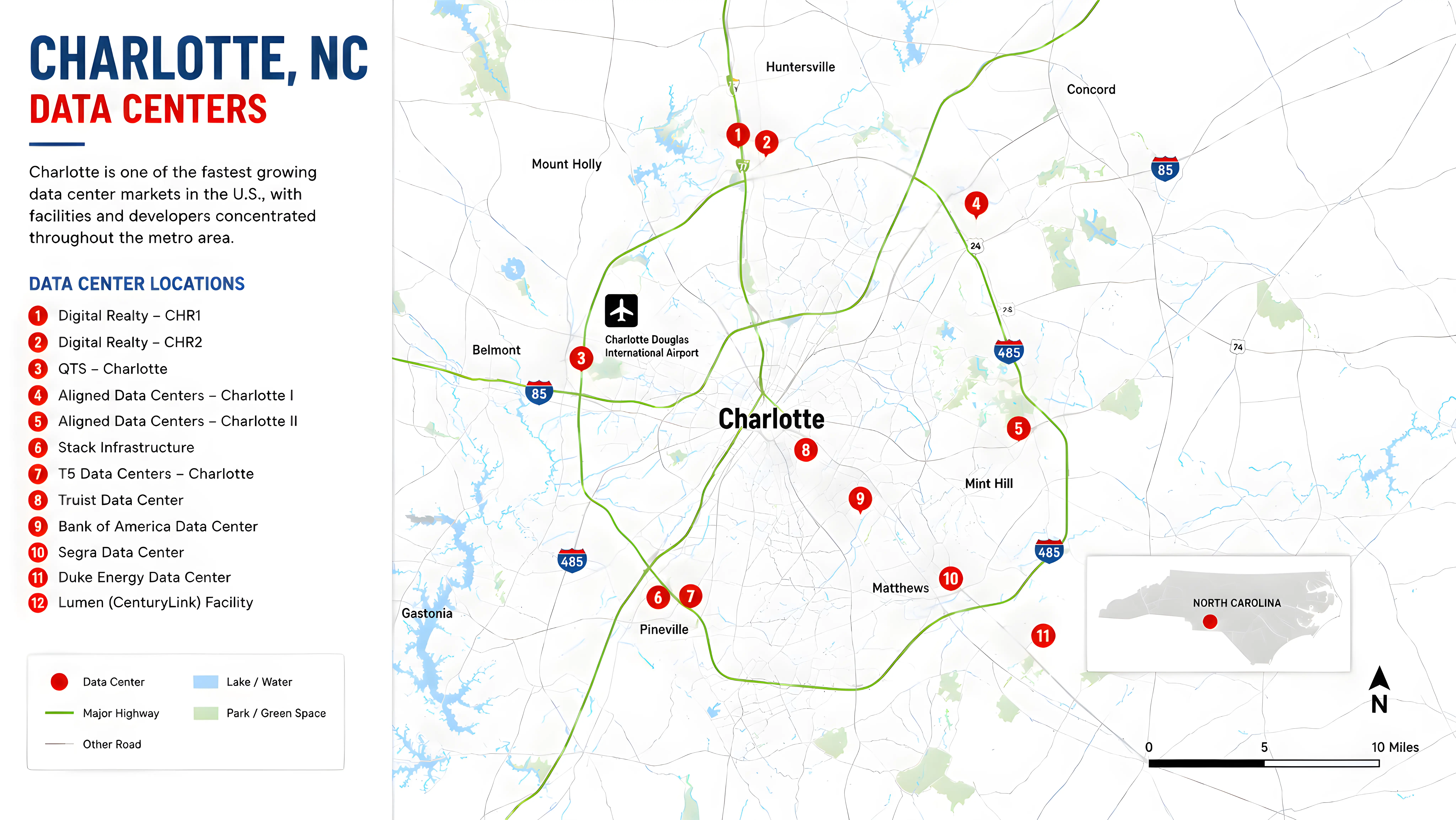
In a decisive move that has sent shockwaves through the technology and infrastructure sectors, the Charlotte City Council recently voted unanimously to enact a 150-day moratorium on all new data center developments. This landmark decision makes Charlotte the newest and largest American city to place a temporary freeze on digital infrastructure applications. The move highlights a growing national conversation about how hyper-scale digital growth impacts local communities.
The Backstory: A Grassroots Movement Hits Uptown Charlotte
This five-month legislative pause did not occur in a vacuum. According to investigative reporting from Liberation News, the moratorium is the direct result of a highly coordinated, mass community movement spearheaded by local residents and grassroots organizations, including the Party for Socialism and Liberation (PSL Charlotte).
The momentum against unchecked data center expansion peaked after a localized petition gathered more than 6,000 signatures from residents opposing a massive, multi-facility data center complex proposed in the middle of a residential East Charlotte neighborhood. For weeks, activists and working-class families packed city council meetings, delivering hours of passionate public testimony to voice deep anxieties about heavy industrial facilities encroaching on their daily lives.
While the council’s moratorium will not retroactively halt or pause infrastructure projects that have already secured zoning approval or are currently under active construction, it places a total freeze on the intake, review, and approval of all new data center applications. This regulatory pause is set to remain in place through the late autumn of 2026, forcing a temporary standstill in Charlotte’s multi-billion-dollar infrastructure pipeline.
Why Communities Are Objecting: The Core Anxieties of Hyperscale Expansion
The growing friction between peaceful residential neighborhoods and the developers of “Hyperscale” data environments typically boils down to three primary local anxieties: resource strain, environmental disruption, and neighborhood displacement.
- Resource Strain and Escalating Utility Costs
Data centers are famously power-hungry and water-intensive operations. In an era marked by increasingly volatile weather patterns and regional droughts, Charlotte residents have expressed deep concerns over the millions of gallons of water these facilities draw daily from local municipal systems for evaporative cooling. Furthermore, the issue is directly tied to the wallets of local consumers. With Duke Energy advancing a proposed electrical rate hike of nearly 20% to fund grid modernization across North Carolina, community advocates argue that working-class citizens are effectively being forced to subsidize the heavy power grid upgrades required exclusively by Big Tech operators.
- Environmental and Quality of Life Disruption
The localized footprint of a data center complex brings immediate physical disruptions that extend far beyond regional carbon accounting. To keep thousands of high-performance servers from overheating, these complexes utilize massive, industrial-scale cooling fans and backup diesel generators. For neighboring homes, this translates into a persistent, low-frequency ambient drone that can severely disrupt sleep and lower property values. Additionally, several proposed facility sites in Charlotte sit directly adjacent to fragile ecological areas, such as the Reedy Creek Nature Preserve, raising immediate alarms among conservationists regarding localized heat islands, runoff, and environmental degradation.
- Neighborhood Displacement and Industrial Zoning
A significant point of contention for local activists is the specific placement of these facilities. Many of the tracts targeted for data center re-zoning directly border historically working-class, diverse, or immigrant communities in East and North Charlotte. Residents feel that these massive, windowless corporate compounds offer almost nothing to the surrounding neighborhood—generating very few permanent, local jobs once construction concludes—while permanently altering the landscape with aggressive industrial zoning, security fencing, and commercial traffic.
The Counter-Argument: Why Restricting Data Centers May Threaten Community Development
While the temporary pause provides Charlotte’s urban planners with much-needed time to study structural code updates and design better zoning guardrails, a prolonged or permanent shutdown on data infrastructure could trigger severe, unintended economic consequences for the city and the state.
The Loss of Vital Municipal Tax Revenues
Data centers are among the most capital-intensive real estate developments in the world. They represent hundreds of millions—often billions—of dollars in direct private investment, creating an incredibly lucrative tax base for local governments. Because data centers house highly valuable servers and switching equipment that are updated every few years, they generate massive, recurring personal property and municipal tax yields. Artificially blocking these developments directly starves local municipalities of the reliable public funds used to build community parks, upgrade public transit, and fund local school districts without raising taxes on residents.
Stifling the Broader Tech and AI Economy
Over the past decade, Charlotte has successfully positioned itself as a premier global financial center, fintech innovator, and advanced optical networking hub. High-density data infrastructure is the literal physical backbone that enables modern financial services, healthcare analytics, and cloud connectivity to exist. As artificial intelligence workloads scale exponentially, a city without adequate, low-latency data center capacity risks falling behind. Chilling the data infrastructure sector risks driving high-tech enterprises, digital innovation, and corporate headquarters to more receptive neighboring states like Virginia or Georgia.
Damaging Regional Manufacturing and Supply Chains
The economic footprint of a data center extends far beyond the data hall itself. Nearby Hickory, North Carolina, is a global epicenter for optical fiber production, anchored by industry leaders like Corning Optical Communications. The massive manufacturing operations in the region rely heavily on the continuous expansion of domestic data networks and regional hyper-scale footprints to sustain production demand. Placing an artificial cap on regional network expansion could create an unwanted cooling effect across manufacturing supply chains, threatening industrial employment and manufacturing investments throughout the Carolinas.
The Bottom Line: Seeking Equilibrium in the 21st Century
Ultimately, Charlotte’s 150-day “homework period” should not be viewed as an outright rejection of technology, but rather as a necessary step toward intentional urban planning. It provides municipal leaders with a brief window to design modernized zoning frameworks, implement strict water-recycling mandates, and ensure that industrial facilities are built in appropriate corridors.
However, treating data centers entirely as a community threat risks starving Charlotte of the foundational infrastructure required to power its future economy. True, sustainable community development requires an intentional balance: demanding corporate environmental accountability and neighborhood protection without turning away the economic engines of the digital age.
Master the Fiber Network Behind the Data Centers
The operations, scaling, and efficiency of modern data centers depend entirely on the high-capacity fiber networks that connect them to the world. To understand how these multi-terabit systems function, handle massive AI workloads, and optimize spectral efficiency, technical professionals must master the physical layer.
Consider advancing your technical capabilities by enrolling in a vendor-neutral Fiber Optic Training in Charlotte with FiberGuide. Explore our comprehensive CONA (Certified Optical Network Associate) and CONE (Certified Optical Network Engineer) training courses to master the fundamentals of modern transport architecture.

Jabulani Dhliwayo is Founder and Technical Director of FiberGuide, a lecturer, scientist, engineer, and optical networking expert with more than 30 years of experience in fiber optics, telecommunications, research, and product development. He develops and delivers advanced CONA and CONE training programs for telecom operators, data centers, and government organizations. His career includes senior technical and product leadership roles at Corning and Yokogawa. His expertise spans DWDM, OTN, coherent optics, ROADMs, and fiber characterization. Dr. Dhliwayo holds a Ph.D. in Physics from the University of Kent, an M.S. in Applied Physics, and a B.S. in Physics.
You can connect with him on Linkedin
Sorry, the comment form is closed at this time.