

30 Jun The Data Center Friction: Balancing Community Backlash with 21st-Century Economic Realities
As artificial intelligence, cloud computing, and digital transformation accelerate, communities across the United States are grappling with an important question: How can we support data center growth while protecting local quality of life?
Artificial intelligence is fueling the largest wave of digital infrastructure investment in history. Behind every AI application, cloud service, video stream, and online transaction lies a network of hyperscale data centers consuming unprecedented amounts of electricity, fiber connectivity, and computing power.
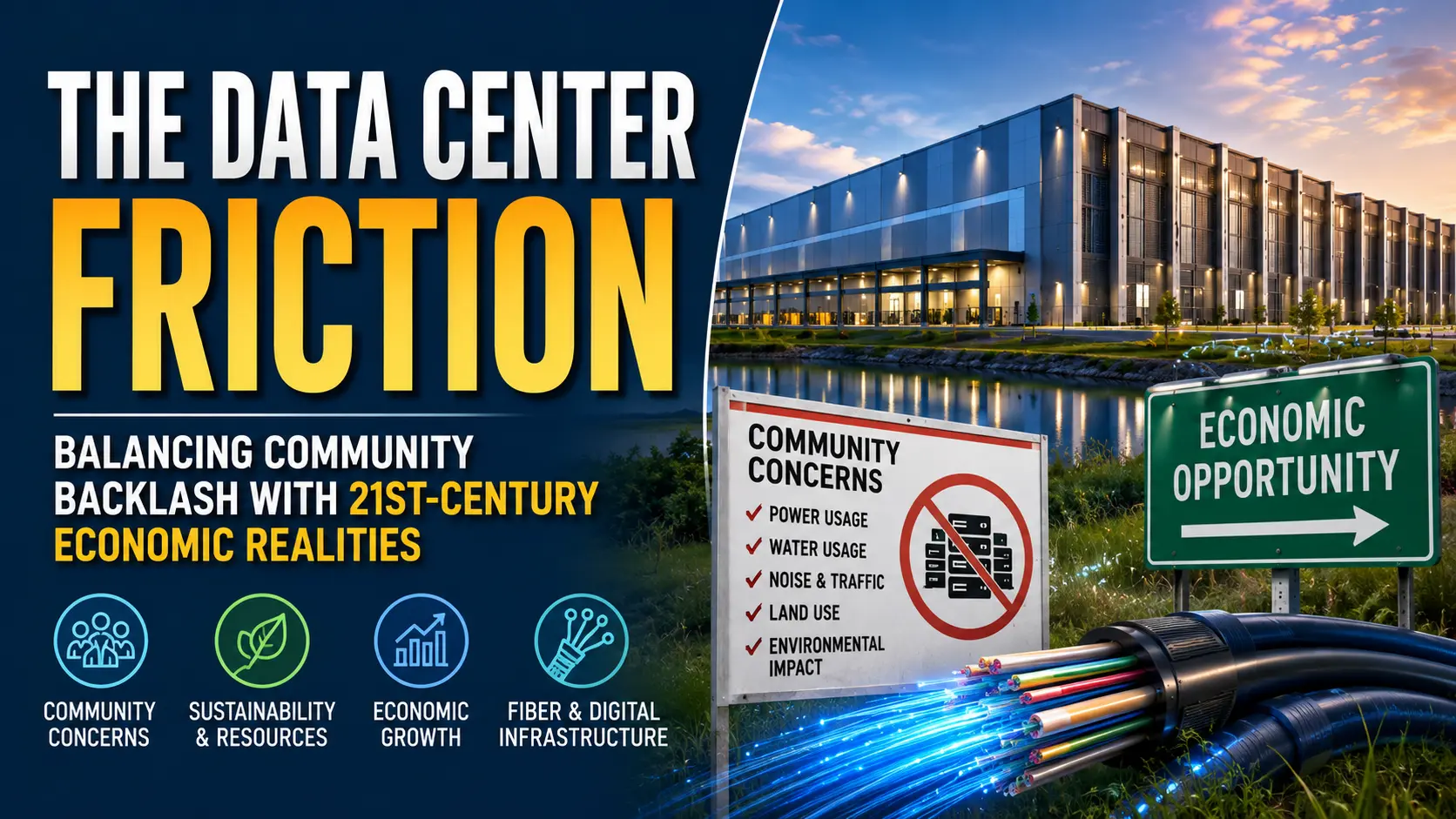
Yet, as demand for AI data centers continues to surge, opposition from local communities is also growing. City councils, county commissions, and state legislatures are increasingly scrutinizing large-scale data center developments because of concerns over power consumption, water usage, noise, traffic, and land use.
The recent 150-day data center moratorium approved by the Charlotte City Council reflects a broader national trend rather than an isolated event. Communities are seeking ways to balance economic development with responsible planning as the digital economy rapidly expands.
A Nationwide Shift in Data Center Development
The United States is experiencing record investment in hyperscale data centers, driven primarily by artificial intelligence, cloud computing, and high-performance computing. However, many proposed projects are encountering significant delays as communities demand stronger environmental safeguards and improved infrastructure planning.
Rather than opposing technology itself, residents are asking whether rapid data center expansion can occur without overwhelming local infrastructure, public utilities, and natural resources. It is a question that is likely to shape infrastructure planning for years to come.
Why Communities Are Challenging New Data Centers
One of the primary concerns is electricity consumption. Modern AI data centers require enormous amounts of power, with today’s largest campuses consuming hundreds of megawatts and future facilities expected to require multiple gigawatts. This has raised questions about electrical grid reliability, new transmission infrastructure, carbon emissions, long-term energy planning, and whether residential customers could ultimately bear part of the cost of expanding the electrical grid.
Water usage is another major issue. Many large data centers rely on evaporative cooling systems that consume significant quantities of water, creating concern in regions already experiencing drought or water shortages. Increasingly, communities expect developers to adopt closed-loop cooling systems, water recycling technologies, and other sustainable approaches that reduce environmental impact.
Residents are also concerned about the visual and environmental effects of hyperscale campuses. Unlike traditional office buildings, data centers operate continuously and require large cooling systems, substations, backup generators, and extensive security infrastructure. These facilities can dramatically alter surrounding neighborhoods, leading to concerns about equipment noise, large industrial buildings, changing landscapes, property values, and the loss of farmland. In response, many communities are encouraging developers to incorporate improved architectural design, landscaping, and larger setbacks to better integrate facilities into their surroundings.
High-Profile Data Center Controversies
Several major projects have become focal points in the national discussion over AI infrastructure.
One of the most closely watched proposals emerged in Utah, where the proposed Stratos AI Campus originally envisioned a massive development spanning tens of thousands of acres. Public debate centered on electricity demand, water availability, wildlife preservation, and the project’s long-term environmental footprint. Following significant community feedback, developers substantially reduced the project’s size while state leaders introduced stricter evaluation criteria for future developments. The project illustrates how community engagement has become an essential component of modern infrastructure planning.
Charlotte’s recent decision to implement a temporary 150-day moratorium on new data center applications reflects a similar approach. The city intends to use the pause to review zoning regulations, utility capacity, environmental impacts, and long-term planning strategies. Rather than signaling opposition to technology, the moratorium represents an effort to ensure that future development occurs in a sustainable and well-managed manner.
Communities across Kentucky, Maine, New York, Virginia, Utah, North Carolina, and several other states are now reevaluating whether existing zoning policies adequately address the scale and complexity of modern hyperscale data centers. Many municipalities are considering temporary pauses while updating planning regulations for future growth.
The Economic Value of Data Centers
While legitimate concerns exist, data centers also generate substantial economic benefits.
Large hyperscale campuses frequently represent investments measured in billions of dollars. Construction supports thousands of jobs while creating demand for engineering firms, electrical contractors, fiber optic installers, equipment manufacturers, and construction companies. The ripple effects extend throughout local economies, supporting numerous suppliers and service providers.
Although data centers typically employ fewer permanent workers than manufacturing facilities, they generate significant property and equipment tax revenue. These revenues often help fund schools, roads, emergency services, parks, and other public infrastructure that benefits the broader community.
Perhaps most importantly, data centers form the backbone of the digital economy. Artificial intelligence, cloud computing, financial services, healthcare research, biotechnology, cybersecurity, advanced manufacturing, and digital media all depend on low-latency computing infrastructure. Regions that fail to provide sufficient digital infrastructure may find it increasingly difficult to attract future technology investment.
The Hidden Impact on the Fiber Optic Industry
One frequently overlooked consequence of slowing data center development is its impact on the broader telecommunications supply chain.
Every hyperscale facility requires enormous quantities of fiber optic cable, optical transceivers, DWDM systems, optical amplifiers, high-capacity Ethernet switches, and structured cabling. Companies throughout the optical networking ecosystem benefit from continued investment in digital infrastructure.
North Carolina’s growing fiber optic manufacturing sector, including companies producing optical fiber, cable, and connectivity products, could experience reduced demand if large-scale data center construction slows significantly. The effects extend far beyond the data centers themselves, influencing manufacturers, installers, system integrators, and network equipment suppliers across the country.
Finding the Right Balance
Communities should not be forced to choose between economic growth and environmental stewardship.
The most successful regions are likely to adopt planning frameworks that encourage responsible development through sustainable water management, energy-efficient cooling technologies, grid modernization, thoughtful zoning, improved architectural design, and meaningful community engagement. These measures can help ensure that data center growth benefits both residents and the broader economy while minimizing environmental impacts.
Conclusion
The debate surrounding AI data centers is ultimately about managing growth responsibly rather than stopping it.
As artificial intelligence continues to reshape the global economy, demand for hyperscale data centers will only increase. Communities that establish clear planning guidelines, invest in resilient infrastructure, and encourage responsible development will be best positioned to attract investment, create high-value jobs, strengthen digital infrastructure, and support long-term economic growth. At the same time, the expansion of AI infrastructure will continue to drive demand for advanced optical networking technologies and the skilled workforce needed to build and operate them. This makes investment in optical networking education and training more important than ever.
If you wish to lean more about data centers and other aspects of optical networking, consider participating in our flagship optical netwoking training programs: Certified Optical Network Associate (CONA) and Certified Optical Network Engineer (CONE).

Jabulani Dhliwayo is Founder and Technical Director of FiberGuide, a lecturer, scientist, engineer, and optical networking expert with more than 30 years of experience in fiber optics, telecommunications, research, and product development. He develops and delivers advanced CONA and CONE training programs for telecom operators, data centers, and government organizations. His career includes senior technical and product leadership roles at Corning and Yokogawa. His expertise spans DWDM, OTN, coherent optics, ROADMs, and fiber characterization. Dr. Dhliwayo holds a Ph.D. in Physics from the University of Kent, an M.S. in Applied Physics, and a B.S. in Physics.
You can connect with him on Linkedin
Sorry, the comment form is closed at this time.